BIS: “combining money, assets and information on a common programmable platform” | digital finance

On 17 June the Bank for International Settlements (BIS) wrote on twitter:


What does “combining money, assets and information on a common programmable platform” mean? I will have to wait untill tomorrow (pre-release) to find out more. It however looks like it is about open finance and central bank digital currency (CBDC).

Apparently – according to the video in the twitter post – smart contracts are playing a role, ‘benefiting consumers’, the alibi always used for financial surveillance proposals.

On this page BiS’ Annual Economic Report 2023 is announced, including a special chapter on CBDC:

The Annual Economic Report 2023, to be released on 25 June, will discuss the challenges facing central banks and the risks to financial stability during the final and most difficult phase of the fight against inflation. The Report discusses the role of fiscal and macroprudential policies and calls for monetary and fiscal policy to work in a coherent way to ensure stability in the long run.

A special chapter, to be released on 20 June, lays out a blueprint for the future monetary system underpinned by central bank digital currency, thus opening up a new era in the joint development of the monetary system and the economy.

It shows what the international financial world is heading for.


More information:

BIS is working on digital finance and CBDC, through a lot of projects. One of the main activities called BIS Innovation Hub, with a lot of projects that mostly are about CBDC, e.g.:

Other BIS-projects:

  • Aurum: “Aurum is a retail CBDC technology prototype, comprised of a wholesale interbank system and a retail e-wallet system, setting up two different types of tokens: intermediated CBDC and stablecoins backed by CBDC in the interbank system. While intermediated CBDC is a direct liability of the central bank, CBDC-backed stablecoins are liabilities of the issuing bank, with its backing assets held by the central bank. The prototype is designed under the principles of safety, flexibility and privacy“
  • Ellipse: “Ellipse is a prototype of an integrated regulatory data and analytics platform that combines both structured and unstructured sources of data that are relevant in real time and to current events. Advanced analytics are applied to those integrated data sources to provide supervisors with early warning indicators, analytics and prudential metrics. It is powered using the Data and Knowledge Platform (DKP), which is being developed by the Monetary Authority of Singapore“.
  • SDMX/FMR: “The FMR enables organisations to ‘get a grip of their metadata’, by externalising their statistical structural metadata with the benefits of maintainability, re-use, standardisation, harmonisation and improved metadata and data governance“.


Addition 21 June 2023
Yesterday the Bank for International Settlements (BIS) announced a blueprint for the future monetary and financial system, that will include programmable central bank money. Read the press release on the special chapter of BIS’ Annual Economic Report 2023.

Geplaatst in English - posts in English on this blog, Financieel recht, onder meer Wft, Wtt, Fraude, witwasbestrijding, Wwft | Tags: , , , , , , , , , | Plaats een reactie

Steelt de gemeente Rotterdam fietsen?

Op 25 mei jl. schreef ik op LinkedIn:


Een verhaal.

Vandaag heb ik met verbazing staan kijken hoe goed uitziende fietsen door mensen met gemeentejasjes aan werden losgeknipt van de hekjes waar ze aan stonden. Ik sprak de mensen er op aan: mij werd uitgelegd dat het om ‘weesfietsen’ gaat, dat zijn goede fietsen (al staan echt dure fietsen niet buiten) die langer dan twee weken niet gebruikt zijn. Dat blijkt uit doordat een eerder aangebrachte sticker of badge niet is verwijderd.
(De gemeente verwijdert ook wrakken, dat is iets anders.)

De fietsen worden door de gemeente verwijderd zonder dat er een mededeling wordt achter gelaten, bijvoorbeeld aan het hek waar de fiets aan vast zat of door een melding in nabije brievenbussen wordt gestopt.
Als de fietseigenaar die een maandje weg was zijn fiets niet terug vindt denkt hij: mijn fiets is gestolen.
Kan hij weten dat de gemeente de fiets heeft mee genomen…

Volgens de gemeentemedewerker komt de eigenaar er wel achter als hij aangifte doet. Maar neemt de eigenaar van zo’n buiten staande fiets wel de moeite? (Niemand heeft dure fietsen buiten staan.)
Verder had ik moeten weten dat ik mijn fiets niet langer dan een paar dagen niet mag gebruiken. In Amsterdam zou een fiets al na 1 dag worden weg gehaald (daar geloof ik niets van).

Is dit diefstal? Wat vinden jullie?

Gemeente Rotterdam #weesfietsen #diefstal


De lezers van dit blog nodig ik van harte uit om te reageren.

Overigens steelt ook de gemeente Hilversum fietsen, lees Bart Mos:


Aanvulling 19 juni 2023
Inmiddels zijn er twee reacties binnen, één over een Amsterdamse ervaring, één van iemand die de APV-vindplaats aangeeft, de derde reactie gaat over een andere Rotterdamse ervaring. Op de derde reactie heb ik gereageerd.

Geplaatst in Bestuursrecht, Grondrechten, Strafrecht | Tags: , , | 4 reacties

AI in de aandacht

Wie over kunstmatige intelligentie (artificial intelligence) en algoritmen wil lezen, heeft het druk. Enige interessante bronnen noem ik hierna.

Nederlandse overheid en sites die zich met overheidsbeleid bezig houden:

Nederlandse burgerrechtenorganisaties:

Engelstalig

  • AI Snake Oil, door Arvind Narayanan en Sayash Kapoor, wetenschappers aan de Princeton universiteit.
  • AlgorithmWatch, a non-profit research and advocacy organization that is committed to watch, unpack and analyze automated decision-making (ADM) systems and their impact on society.
  • The Markup, Amerikaanse nieuwssite over privacy c.a. met artikelen als Decoding the Hype About AI, A conversation of Julia Angwin with Arvind Narayanan, 28 januari 2023.

Duitstalig

Ook in de klassieke media wordt druk over het onderwerp geschreven. Een greep:

Wetenschappers:


Emily Bender:


Volker Türk, United Nations High Commissioner for Human Rights:


Aanvulling 19 juni 2023
Artikelen van Bits of Freedom, Privacy First en Infosperber toegevoegd en een NPO Radio 1 uitzending genoemd.

Geplaatst in ICT, privacy, e-commerce | Tags: , , , | Plaats een reactie

Politiek, neem controle over AI | petitie Verhoeven c.s.

In het kader van mijn AI-serie van vandaag attendeer ik op de petitie ‘Politiek, neem controle over AI’, een initiatief van onder meer voormalig Tweede Kamerlid Kees Verhoeven.

Bij de ondertekenaars staan verstandige mensen zoals Maxim Februari, Christiaan Alberdingk Thijm, Victor Gevers, Brenno de Winter, Reijer Passchier en vele anderen.

Voor achtergrondinformatie wordt naar de site pauseai.info verwezen.

De tekst die bij de petitie hoort:

Politiek, neem controle over AI

De opkomst van AI biedt kansen, maar brengt ook enorme risico’s met zich mee. Daarom doen wij een oproep aan de Nederlandse politiek: neem controle over ontwikkeling van AI. Zorg dat de mens bepaalt hoe een toekomst met AI eruitziet. Niet andersom.

Wij roepen de Nederlandse Tweede Kamer en het kabinet op tot het nemen van de volgende maatregelen:

  • Neem een leidende rol in Europa en voer via EU-wetgeving hoogstaande regulering van AI-toepassingen door. Neem de AI-verordening nog dit jaar aan. Zorg dat geavanceerde AI, zoals foundation models, onder ‘high risk’ vallen, reduceer systemische risico’s en dwing transparantie af over de training van het model.
  • Versnel de aanname van het AI-verdrag in de Raad van Europa en (mede-)initieer het opzetten van een internationale top over AI op korte termijn.
  • Vraag instanties met kennis en ervaring van AI om advies, verzoek om een snelle update van het WRR-rapport “Opgave AI” en koppel daaraan direct een rijksbreed actieplan.
  • Laat door ieder ministerie in kaart brengen op welke gebieden AI fundamentele invloed zal uitoefenen en breng in kaart waar extra regelgeving nodig is om die invloed in goede banen te leiden. Stel als overheid ook een AI-inkoopstrategie vast.
  • Informeer de Nederlandse bevolking op laagdrempelige wijze over de kansen en bedreigingen van de inzet van AI.
  • Bewaak het onderscheid tussen menselijk en kunstmatig. Dwing af dat duidelijk is wanneer een uiting met AI tot stand is gekomen of wanneer een mens communiceert met AI. Dwing AI-ontwikkelaars publieke verantwoording af te leggen over de ontwikkelkeuzes die ze maken.
  • Het is onduidelijk wat de investeringen in onderzoek naar risico’s van AI zijn, maar wel zeker is dat hier veel minder FTE’s aan besteed worden dan aan onderzoek naar AI-kansen. Daarom moet er de komende jaren worden toegewerkt naar 300 voltijdsonderzoeksposities op de vakgebieden AI Safety, AI en rechtsstaat en existentieel risico in een nieuw op te zetten onderzoeksinstituut en/of bij bestaande instituten.

Er is weinig tijd om bovenstaande doelen te realiseren. Al eerder veranderde de wereld door revolutionaire technologie, maar de snelheid waarmee dat gebeurt neemt iedere keer toe. Door AI is de wereld aan het veranderen met een ongekende -en deels ongeziene- snelheid en richting. We moeten vandaag beginnen met het organiseren van menselijke controle en grip op kunstmatige intelligentie.

Geplaatst in Grondrechten, ICT, privacy, e-commerce | Tags: , | Plaats een reactie

European AI-optimism: “Is Secure and Trusted AI Possible? The EU Leads the Way”

The European Union Agency for Cybersecurity (ENISA) published the article Is Secure and Trusted AI Possible? The EU Leads the Way, expressing optimism. Let’s hope they are right.

Geplaatst in English - posts in English on this blog, Europa, Grondrechten, ICT, privacy, e-commerce | Tags: , , , , | Plaats een reactie

EBA’s report on 2022 and key priorities for 2023

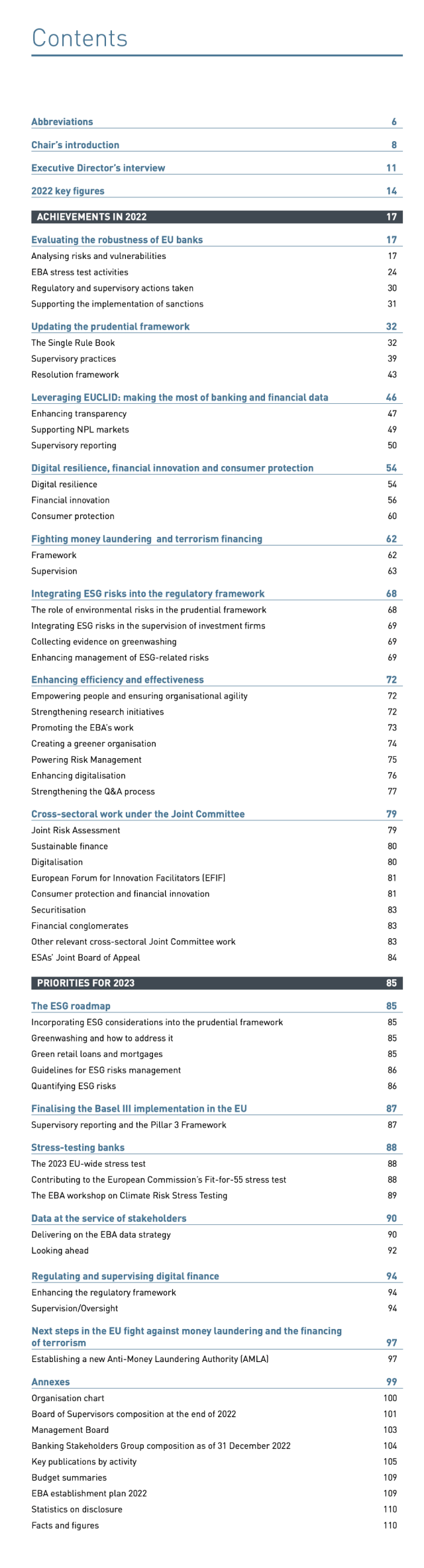
​The European Banking Authority (EBA) published its annual report that sets out the activities in 2022 and provides an overview of the key priorities for 2023.

It is amusing to see EBA thinks it delivers ‘products‘ and that it can claim ‘achievements‘. It still is remarkable that public sector organisations find it necessary to use private sector terminology. EBA praises itself highly when they claim their rulebook is ‘evidence-based’. That fits well with the presumption that the world is controllable and humans adapt to theoretical concepts. Unfortunately, reality is different.

Nevertheless, it is to be hoped that EBA plays a useful role in supervision of financial institutions (FIs).

AML/CFT
EBA supervises FIs and national authorities in regard of anti-money laundering (AML) and countering financing of terrorism (CFT). On pages 62-67 of the report they write that they

implemented a holistic regulatory framework to ensure a consistent approach to identifying, assessing and managing ML/TF risk across all areas of supervision and across all stages of a financial institution’s life cycle

This is done through a lot of guidelines. The chapter describes organisational activities, like reviews of competent authorities’ approaches, implementation reviews and training.

EuReCa, the black sheep database of FI’s
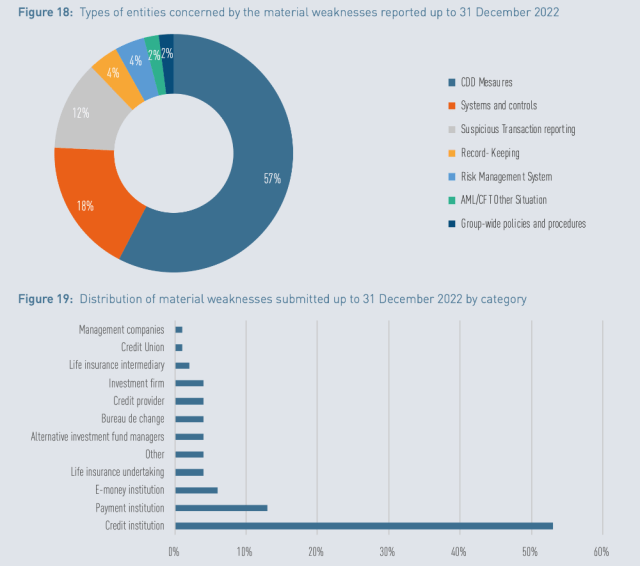
EBA reports on the central AML/CFT database EuReCa, which brings together information on serious deficiencies in individual FIs’ systems and checks that expose these institutions to money laundering/ terrorist financing risk, and the measures national authorities took to correct those deficiencies. According to EBA EuReCa has become a key tool strengthening AML/CFT supervision and coordinating supervisory efforts across the EU.

Figures on EuReCa:


More information:

Geplaatst in English - posts in English on this blog, Europa, Financieel recht, onder meer Wft, Wtt, Fraude, witwasbestrijding, Wwft | Tags: , , , | Plaats een reactie

Gelijkstelling van de fiscale ubo met de antiwitwasubo en het onrechtmatig verstrekken van persoonsgegevens aan landen buiten de EU | Wwft, AML, CFT

In 2017 signaleerde ik al het merkwaardige fenomeen dat de uiteindelijk belanghebbende (ubo) in het fiscale recht (degene met een direct of indirect economisch belang, soms gecombineerd met zeggenschap) wordt gelijk gesteld met de ubo in de criminaliteitsbestrijding (ook bekend als ‘witwasbestrijding’), terwijl de laatstgenoemde ubo regelmatig fiscaal irrelevant is.

In het kader van internationale fiscale uitwisseling van persoonsgegevens kiezen overheden er voor om het veel ruimere ubo-begrip uit de criminaliteitsbestrijding te gebruiken, met als gevolg dat er persoonsgegevens worden uitgewisseld van mensen die niet fiscaal relevant zijn.

Verschaffing van persoonsgegevens aan de Verenigde Staten
Onlangs zag ik – toen ik het FATCA-verdrag tussen Nederland en de VS bekeek – dat overheden vrolijk doorgaan met die veel te ruime verstrekking van persoonsgegevens aan landen buiten de EU. In het FATCA-verdrag staat dat gegevens van ‘uiteindelijk belanghebbenden’ van voor de VS relevante entiteiten moeten worden verschaft aan de Amerikaanse belastingdienst, met een definitie die in de Nederlandse vertaling van het verdrag wordt als volgt luidt:

Onder de uitdrukking „uiteindelijk belanghebbenden” worden de natuurlijke personen verstaan die zeggenschap uitoefenen over een entiteit. In het geval van trusts wordt hieronder verstaan de settlor, de trustees, de eventuele protector, de begunstigden of categorie begunstigden en eventuele andere natuurlijke personen die de feitelijke zeggenschap uitoefenen over de trust en in het geval van andere juridische overeenkomsten dan een trust wordt hieronder verstaan personen in dezelfde of een vergelijkbare positie. De uitdrukking „uiteindelijke belanghebbenden” wordt uitgelegd op een wijze die verenigbaar is met de aanbevelingen van de Financial Action Task Force.

De in het citaat genoemde aanbevelingen van de Financial Action Task Force (FATF), de inofficiële wereldregering onder leiding van de VS, hebben betrekking op criminaliteitsbestrijding. Iemand die uiteindelijk belanghebbende (ubo) is voor de criminaliteitsbestrijding, hoeft niet een persoon te zijn aan wie de Amerikaanse belastingdienst een aanslag mag opleggen.

Verschaffing van persoonsgegevens aan de VS in strijd met AVG en Handvest
Gevolg van deze aanpak, die ook in andere fiscale uitwisselingsregelgeving is terug te vinden, is dat van veel meer mensen persoonsgegevens worden doorgegeven dan nodig is voor de belastingheffing van de VS. Dit is in strijd met de AVG en het Europees Handvest. Het is hoog tijd dat er tegen wordt opgetreden, zeker nu persoonsgegevens in de VS en andere landen buiten de EU niet veilig zijn en er in die landen geen behoorlijke rechtsbescherming is tegen de fiscale autoriteiten.

Geplaatst in Belastingrecht, Europa, Financieel recht, onder meer Wft, Wtt, Fraude, witwasbestrijding, Wwft, Grondrechten | Tags: , , , , , , | Plaats een reactie

Transparency International and Tax Justice Network publish ‘expert’ papers on beneficial ownership and completely disregard fundamental rights of European citizens

A private group named ‘Network of Experts on Beneficial Ownership Transparency‘, NEBOT, that is financed by the European Commission, has published papers through the European Commission. NEBOT consists of two non-profit organisations (NPOs) and one university partner:

  • Transparency International (TI)
  • Tax Justice Network (TJN)
  • Transcrime – Università Cattolica del Sacro Cuore (Transcrime – UCSC)

TI and TJN are powerful NPOs funded by the EU and by the governments of US and UK to promote certain public policies on crime fighting (anti-money laundering, AML, and countering financing of terrorism, CFT). Transcrime is a university organisation that deals with AML and CFT and cannot be suspected of having practical knowledge of the companies that have to comply with the regulations.

It is interesting to see that TI and TJN are transformed into ‘experts’ on beneficial ownership transparency, when they are only enabled to present their government-approved political goals as ‘expert-information’.

Six papers
The papers are:

Paper 1 Beneficial owners of European companies (and related risks)
Paper 2 Verification and Quality of Beneficial Ownership Information in the EU
Paper 3 Beneficial Ownership Registration for Trusts Gaps and Loopholes
Paper 4 The Beneficial Ownership Definition for Companies Challenges and Opportunities
Paper 5 Beneficial ownership registers in the EU: Progress so far and the way forward
Paper 6 Linked Beneficial Ownership Data? Challenges and Opportunities

I did not have time to read the full papers, but the abstracts show the familiar themes and hobbys of the AML/CFT propagandists, as do some of the conclusions I read.

Paper 1 Beneficial owners of European companies (and related risks)
According to the abstract in the first paper the authors looked at the ownership anomalies of the companies which owned real estate properties in Paris.

Paper 2 Verification and Quality of Beneficial Ownership Information in the EU
The second paper on the quality of de beneficial owner (BO) registration only deals with organisational circumstances and does not cover the ‘discrepancies’ caused by different interpretations of the BO-definitions. Dutch example: banks think that a shareholder is a BO when he has 25% or more of the shares, though in reality a shareholder is a BO when he or she has more than 25% of the shares. As a result banks report a lot of discrepancies to the Dutch BO-register.

Paper 3 Beneficial Ownership Registration for Trusts Gaps and Loopholes
The third paper is on the trust, a legal form that does not exist in EU-counties (it is an Anglo-Saxon form), something that is not mentioned in the abstract. The policy recommendations in 4.1 are – as far as I can see – already covered in the latest European AML-CFT legislation. Only 1.c) looks new (“where any party (not just the trustee) is resident in an EU country“), that includes beneficiaries, the protector, the initiator and “any other natural person exercising ultimate control over the trust by means of direct or indirect ownership or by other means” (see AMLD4, revised version, article 3). The authors want the legal validity of a trust being based on having registered its BOs, of course that depends on the law applicable to the trust, e.g. British law. The authors demand public access of the BO-information of trusts, forgetting about fundamental rights and about the decision of the EU-court.

Paper 4 The Beneficial Ownership Definition for Companies Challenges and Opportunities
According to the authors of the paper:

Currently, the BO definitions lack clarity, are subject to different interpretations and implementation by Member States, and most problematically, may not be identifying all the relevant individuals

That is peculiar as the definitions should be based on AMLD4, revised version. It is amazing that the authors want about everyone included in a revised BO-definition: “a highly comprehensive BO definition that covered as many individuals as possible“. They suggest:

To make the definition enforceable, the criteria on control should also become more “mechanical”, i.e. similar to following a simple check list, such as identifying every natural person with a power of attorney, anyone with control over the bank accounts, anyone who participates in the board of directors, etc.

As a consequence unnecessary personal data of people will be processed by authorities and obliged entities and the original purpose of AML/CFT is forgotten. This proposal is against the data minimalisation principles of GDPR. This is going much too far. It shows how dangerous AML/CFT legislaton is for the fundamental rights of Europeans.

Paper 5 Beneficial ownership registers in the EU: Progress so far and the way forward
The authors express an unfounded belief in the usefullness of BO-registers and seem to have missed the decision of the EU-court on public access. Not surprisingly the authors discovered the implementation of the BO-registers has not been without problems. Europe as usual was much too optimistic about the time and effort necessary.

In the conclusion they of course repeat the familiar mantra:

The analyses carried out for this paper show that beneficial ownership registers are an important tool for competent authorities, obliged entities, and civil society to prevent, identify, and tackle money laundering and financial crime in the EU.

This remains untrue, even if it is repeated a million times.

In the conclusion they also keep promoting public access of the BO-register and ignore the data protection risks attached to the BO-register (these risks are also relevant for the whole concept of privatisation of the fight against crime). Of course no measures are proposed to protect the data protection interests of the people in the register. It is the opposite: the authors want to enable every member of the public to download the full data of BO:

Member States should:

  • Provide API access to every type of end-user national and foreign competent authorities, obliged entities and the public.
  • Make sure the API enables the download of datasets and useful features such as delta updates.
  • Ensure that data is made available in a structured format, for example, in line with Open Ownership’s Beneficial Ownership Data Standard (BODS).
  • Provide adequate search functions for all types of end-users, allowing for searches using parts of the name of a legal entity and beneficial owner.
  • Improve the conditions for the interconnection of registers with other databases, including the implementation of unique identifiers for both legal entities and natural persons (set at the international level).
  • Ensure that all functionalities of the register available to competent authorities and obliged entities are also available to the public.

The authors completely ignore the fundamental rights of people in the BO-register. It makes me wonder what powers are behind TI and TJN these kinds of measures are being proposed.

It is strange that the authors think that there are ‘entities that carry high money laundering risks’ and that do not yet have to register their BOs. It looks as if the authors of this paper have insufficient knowledge of current AML/CFT legislation and a complete disregard of fundamental rights.

Paper 6 Linked Beneficial Ownership Data? Challenges and Opportunities
This paper discusses the use of BO-data and combining the information with other sources. It is clear to see that the people registered as BOs in future will be monitored by both the autorities and by private parties that have the money and the resources to do that.  The technical recommendations (part IV) show the way this surveillance can be achieved. In the conclusions the authors only speak about “investigating and tracing illicit financial flows“. They do not inform the public about the fact that in these investigations they will monitor every BO (and probably every citizen) in the world and will collect a vast amount of personal data.

Read the conclusions:

Conclusions

As demonstrated in the case studies, linked data can significantly boost the possibility for investigating and tracing illicit financial flows. This can be done through using various datasets, including beneficial ownership data, public procurement, real estate registers, company registers and others. Data-linking helps to identify inconsistencies across databases, as well as reveal otherwise hidden connections between companies or individuals.

However, there are many challenges along the way to getting a good match between data and being able to extract as much information as possible from the linked datasets. The absence of unique identifiers, especially when it comes to working with multiple countries, imposes significant limitations that cannot be overcome simply or easily by advancing the technical skills of the people working with data. Different units of analysis require additional efforts to align the datasets and can frequently result in information loss due to the higher level of observations. Finally, the variables themselves can limit comprehensive analysis due to the low quality of observations, missing values, data errors and other issues.

Putting additional efforts into developing and monitoring the implementation of data standards in governmental agencies as well as making data open to the general public and NGOs and allowing them to use it for independent investigations would significantly boost dark money tracing and increase the efficiency of monitoring.

Final remark
The papers nicely document the political views of TI and TJN and their disinterest in fundamental rights and practical feasibility.

I advise the European Commission, the Council and the Parliament, not to follow up the recommendations of these ‘experts’ and to comply with European fundamental legal principles.


Note

[1] According to the justification, the content of each paper is the responsibility of the respective authors, this is the text of paper 1 (is similar in the other papers):

This project is performed by Transparency International Secretariat (TI-S), together with Tax Justice Network (TJN), Transcrime – Università Cattolica del Sacro Cuore (Transcrime – UCSC) and the Government Transparency Institute (GTI), under a contract with the European Union represented by the European Commission. The opinions expressed are those of the authors and do not necessarily represent the views of all NEBOT members.

This document has been prepared for the European Commission. However, it reflects the views only of the authors, and the Commission cannot be held responsible for any use which may be made of the information contained therein. The European Commission is not liable for any consequence stemming from the reuse of this publication.


More information:

  • Papers by the Network of Experts on Beneficial Ownership Transparency, NEBOT, included in: Final report annexes Preparatory action, Capacity building, programmatic development and communication in the context of the fight against money laundering and financial crimes, published by the European Commission [*], 2023.
  • The papers are the annex to: Final report, Preparatory action, Capacity building, programmatic development and communication in the context of the fight against money laundering and financial crimes, published by the European Commission [*] 2023.


[*] Directorate-General for Financial Stability, Financial Services and Capital Markets Union.

Geplaatst in English - posts in English on this blog, Europa, Financieel recht, onder meer Wft, Wtt, Fraude, witwasbestrijding, Wwft, Grondrechten, Ubo-register | Tags: , , , , , , , , , | Plaats een reactie

Rechtsbescherming in de WIB – geen aandacht voor het FATCA-verdrag en uitwisseling buiten de EU

De staatssecretaris van Financiën beantwoordde op 12 juni vragen over de rechtsbescherming in de Wet op de internationale bijstandsverlening bij de heffing van belastingen (WIB), die zijn terug te lezen in het verslag.
Het is opmerkelijk dat – ondanks alle commotie rond de schade die het FATCA-verdrag voor inwoners van Nederland oplevert – in het verslag aandacht ontbreekt voor de toetsing van belastingverdragen en toetsing van de rechtsstatelijkheid van de belastingstelsels van wederpartijen van buiten de EU bij fiscale verdragen.

In het verslag gaat het vooral over gegevensuitwisseling met andere EU-landen [*].

Waar is de FATCA?
Eerder werd een onderzoek over rechtsbescherming in de WIB bekend gemaakt, waar ik in februari dit artikel over schreef. Daarin constateerde ik dat aandacht ontbreekt voor het FATCA-verdrag met de Verenigde Staten, terwijl door dat verdrag inwoners van Nederland met de Amerikaanse nationaliteit grote schade lijden. Die schade is gevolg van internationaal afwijkende fiscale systeem van de Amerikanen, ‘Citizenship-Based Taxation’, dat zij kennen als enige in de wereld. Zowel ‘accidental Americans’ als overige inwoners van Nederland ondervinden schade van de onrechtmatige Amerikaanse fiscale regelgeving die door middel van het verdrag in Nederland wordt geïmporteerd.

Verslag 12 juni: opnieuw geen aandacht voor toetsing van belastingverdragen met landen van buiten de EU
Bij uitwisseling door de Nederlandse overheid van fiscale gegevens met landen binnen de EU is het voor inwoners van Nederland makkelijker om rechtsbescherming te krijgen en moeten EU-landen aan bepaalde Europese standaarden voldoen. Met landen buiten de EU is dat totaal anders en kan sprake van zijn onrechtmatige regelgeving.

Zo is gegevensbescherming in de Verenigde Staten onvoldoende geregeld, ontbreekt een volwassen – vanuit Europa bereikbare en betaalbare – rechtsbescherming en kent de VS fiscale en andere regelgeving die in strijd is met internationale rechtsnormen. Het systeem van Citizenship-Based Taxation, dat de Amerikanen kennen, schendt de grondrechten van Europese inwoners. Ook bij andere landen buiten de EU kan sprake zijn van ernstige gebreken.

Het ontbreken van uitgebreide aandacht voor dit onderwerp in het kader van de rechtsbescherming in de WIB is daarom zeer zorgelijk. Kennelijk heeft men van de FATCA-problematiek niet geleerd.

Rechtsbescherming in derde landen
Opvallend is dat de staatssecretaris een naïef vertrouwen in de rechtssystemen van andere landen heeft. Op een vraag over ontlasting van de Nederlandse rechtspraak wordt geantwoord:

De belastingplichtige heeft in de staat waaraan de inlichtingen zijn verstrekt een rechtsingang als die staat aan hem een belastingaanslag oplegt. In een procedure tegen die aanslag kan de belastingplichtige de rechtmatigheid van de inlichtingenuitwisseling aan de orde stellen.

Dat mag misschien binnen de EU van toepassing zijn, maar in bijvoorbeeld de VS is dit praktisch en juridisch onmogelijk.

Onderscheid EU en overige landen?
Een vraag over het maken van onderscheid tussen uitwisseling met EU-landen en ‘derde staten’ wordt onbevredigend beantwoord. De tekst van de vraag en het antwoord:

De leden van de VVD lezen in het onderzoek dat er geen aanleiding is om onderscheid te maken tussen inlichtingenvergaring ten behoeve van uitwisseling aan andere lidstaten en derde staten. Zij vragen aan te geven waarom het kabinet geen aanleiding ziet om een onderscheid te maken tussen deze situaties en of kan worden gegarandeerd dat de privacy van de belastingplichtige is gewaarborgd ten aanzien van alle derde staten, en, zo nee, waarom is er dan geen aanleiding om een onderscheid te maken tussen deze situaties.

De fiscale gegevensuitwisseling met EU-lidstaten vindt plaats op basis van de Administratieve samenwerkingsrichtlijn (DAC). In het kader van de privacy van belastingplichtigen geldt voor alle EU-lidstaten de Algemene Verordening Gegevensbescherming. Nederland wisselt fiscale gegevens uit met derde staten op basis van het multilateraal Verdrag inzake wederzijdse administratieve bijstand in belastingzaken (WABB-verdrag). Uitsluitend na een uitgebreid beoordelingsproces, uitgevoerd door het Global Forum on Transparency and Exchange of Information for Tax Purposes (Global Forum), kan een staat deelnemen aan het WABB-verdrag. Onderdeel van dit proces is een review van het raamwerk inzake Tax Confidentiality. Zonder goede beoordeling op dit onderdeel kan een staat niet deelnemen/geen partij worden van het WABB-verdrag en zal geen gegevensuitwisseling tot stand komen. Staten die partij zijn bij het WABB-verdrag worden periodiek door het Global Forum gereviewd, waaronder op het onderdeel Confidentiality and Data Safeguards.

Mij is niet bekend of de VS lid is van het WABB-verdrag, maar als dat zo is, begrijp ik niet waarom het Amerikaanse juridische systeem (met onder meer Citizenship-Based Taxation) en de Amerikaanse gegevensbescherming door de ‘toetsing’ van het Global Forum zijn gekomen. Misschien dat een van de lezers van dit artikel mij wijzer kan maken.

Uitwisselingsgegevens zijn geheim
Naar aanleiding van een vraag over uitwisselingsgegevens per land antwoordt de staatssecretaris:

Op grond van de Administratieve Samenwerkingsrichtlijn kan ik het gevraagde overzicht niet delen. De Administratieve Samenwerkingsrichtlijn verplicht Nederland tot geheimhouding van informatie die tussen staten wordt gecommuniceerd. Voor gebruik anders dan de doeleinden waarvoor gegevens en inlichtingen worden verstrekt, en derhalve ook voor de openbaarmaking van statistische data, is toestemming van de betrokken staten vereist. Nederland vraagt staten niet om toestemming voor openbaarmaking van statistische data, en bovendien staat het landen vrij die toestemming te weigeren. Bovenstaande leidt ertoe dat het gevraagde overzicht niet gedeeld kan worden.

Toetsing verdragen
Het is treurig om te zien dat het belangrijkste probleem van de WIB, de fiscale uitwisseling met landen buiten de EU, zoals de VS met zijn onrechtmatige regelgeving, onvoldoende aan de orde komt.


Noot

[*] Zie ook de passage in het verslag over de aard van het onderzoek:

De leden van de VVD-fractie vragen of bij de uitvoering van het onderzoek derden zijn geconsulteerd.

De centrale vraag bij het onderzoek was of de rechtsbescherming in de WIB, mede gelet op het arrest van het HvJ EU van 6 oktober 2020, voldoende is gewaarborgd en of een onderscheid in rechtsbescherming bij inlichtingenverstrekking aan een andere EU-lidstaat of aan een derde land gerechtvaardigd en wenselijk is. Het onderzoek had dus een juridische insteek. Daarom is er literatuuronderzoek gedaan, waarbij is gekeken naar de Richtlijn 2011/16/EU, verdragen, het OESO-modelverdrag en bijbehorend commentaar, wetgeving, jurisprudentie en vakliteratuur. Ik ben tot de conclusie gekomen dat belanghebbenden in het kader van een onderzoek in het kader van internationale gegevensuitwisseling een doeltreffende voorziening in rechte hebben en de rechtsbescherming in de WIB dus voldoende is gewaarborgd. Vervolgens heb ik gewogen of er desondanks aanleiding is om verdergaande rechtsbescherming te bieden. Daarbij heb ik ook gekeken naar verschillende bijdragen die hierover zijn verschenen in de fiscale vakliteratuur. Op die manier zijn ook de standpunten van derden meegewogen bij de beoordeling of er sprake is van voldoende rechtsbescherming in deze situaties.


Meer informatie:

12 juni 2023

  • Verslag van een schriftelijk overleg met antwoorden van de staatssecretaris, 12 juni 2023, site Tweede Kamer.
  • Beslisnota inzake Antwoorden op vragen commissie over het onderzoek rechtsbescherming in de WIB, 12 juni 2023, site Tweede Kamer.

7 juni 2023

  • Lijst van vragen en antwoorden over de Fiscale beleids- en uitvoeringsagenda, 7 juni 2023, site Tweede Kamer.

maart 2023

  • Inbreng verslag van een schriftelijk overleg over het onderzoek rechtsbescherming in de WIB, 30 maart 2023, site Tweede Kamer.
  • Convocatie inbreng schriftelijk overleg (v.s.o.) Onderzoek rechtsbescherming in de WIB , 10 maart 2023, site Tweede Kamer.

8 februari 2023

  • Brief staatssecretaris van Financiën, Onderzoek rechtsbescherming in de WIB, 8 februari 2023, site Tweede Kamer.
  • Bijlage bij de brief van de staatssecretaris van Financiën, over Rechtsbescherming in de WIB, 8 februari 2023, site Tweede Kamer.
  • Beslisnota bij de brief van de staatssecretaris van Financiën over rechtsbescherming in de WIB, 8 februari 2023 openbaar gemaakt, site Tweede Kamer.


Achtergrondinformatie over de manier waarop de Verenigde Staten mensenrechten schendt van mensen met de Amerikaanse nationaliteit: introductie, berichten op dit blog, overzicht van berichten van derden, informatiebronnen.

Geplaatst in Belastingrecht, Financieel recht, onder meer Wft, Wtt, Fraude, witwasbestrijding, Wwft, Grondrechten | Tags: , , , , , , , , | Plaats een reactie

What will come out of Europe’s Pandora Box in regard of AML/CFT?

Today AML/CFT is one of the subjects on the agenda of the European Parliament, (source):

MEPs set out their priorities to fight tax abuse and money laundering
MEPs will debate on Wednesday and vote on Thursday on their recommendations sparked by the evidence uncovered by the Pandora papers and other data leaks.
The report calls for the quick adoption by the EU of already-proposed legislation, and a greater commitment to correctly implementing and enforcing existing agreements. MEPs also call for more reforms, such as more effective measures to deal with practices used to attract foreign wealth through tax schemes, and taking into account the existence of digital nomads.
The recommendations are the result of work carried out by the European Parliament’s tax matters subcommittee, which held a number of public hearings and undertook fact-finding visits to various European countries.

Further information
* Steps of the procedure
* Press release following the committee vote (21 March 2023)
* Press release on the work of the subcommittee on tax matters

According to the agenda of the Parliament the report will be discussed today between 13 and 22 hour.


Pandora report

In March this year I wrote on the draft report. Unfortunately, I could not find the final report at the time. Today it looks like the final version has been published here. The report still suggests there are a lot of Europeans in de Pandora Papers and that they were all having illegal activities, though other sources say that these Papers are of limited importance for Europe. The Pandora report contains all sorts of elements relevant for AML/CFT.

Some topics in the final report (marking by me):


  • On the ‘enabler’ proposal (article):

33. Highlights the limitations of self-regulation of the non-financial intermediary sector; welcomes the fact that the Commission is preparing a new legislative proposal on regulating intermediaries through an act securing the activity framework of enablers in order to tackle the role of enablers involved in facilitating tax evasion and aggressive tax planning; urges the Commission to ensure that the framework includes robust enforcement against intermediaries creating and operating schemes which enable tax evasion and aggressive tax planning, as well as facilitating and contributing to the concealment of wealth and assets; in this context, urges the Commission to continue to improve information-sharing among Member State tax administrations and cooperation on the global stage; awaits the Commission proposal, which should be targeted and proportionate; (…)

68. Calls on the US Congress to pass the bill for the Establishing New Authorities for Businesses Laundering and Enabling Risks to Security Act (ENABLERS), which would require the non-financial and intermediary sector to carry out due diligence obligations on their customers, as recommended by Financial Action Task Force (FATF) standards;


  • On ‘high-net-worth individuals’ (sounding as if they are all criminals or potential criminals):

34. Highlights the Directive on Administrative Cooperation (DAC8) proposal from the Commission, which extends the automatic exchange of advance cross-border rulings in DAC6 to cover high-net-worth individuals; emphasises the importance of honest and fair cooperation between national tax authorities to make the system of exchange of information failproof; (…)
37. Takes note of the fact that, as the Pandora Papers have exposed, schemes to shield the assets of high-net-worth individuals from state authorities through corporate offshore services have become highly sophisticated; notes that the revelations showed how wealthy individuals pay little to no taxes by changing their country of tax residency and reallocating capital across borders; (…)
41. Observes, in parallel, a trend for countries, including EU Member States, to adopt legal frameworks designed to attract high-net-worth individuals, foreign pensioners and highly skilled workers to invest or live in their territory, notably granting them generous tax benefits and exemptions which do not apply to nationals, in addition to offering golden visas and selling citizenship opportunities; points out that these kinds of opportunities may have benefited Russian oligarchs who have since had targeted sanctions imposed on them; (…)
45. Notes that governments generally use two instruments to attract taxpayers and mobile tax bases for personal income and wealth taxation: (top) tax rates and preferential tax arrangements targeted at income- and wealth-rich foreigners;
46. Takes note of the increasing number of tax regimes in EU Member States which aim to attract foreign ‘digital nomads’, high-net-worth individuals or pensioners; notes that some tax regimes present significant potential for abuse, which erodes the tax bases of other countries; highlights that, according to research by the EU Tax Observatory, many Member States have specific tax regimes designed to attract foreign-earned income or wealth which, according to the researchers, pose varying degrees of harmfulness;
48. Is concerned that there is considerable scope for harmful competition in this field and widening social and economic inequalities, as tax-induced mobility is high among income – and wealth-rich taxpayers – and non-mobile income earners end up paying proportionately higher taxes than mobile income earners; (…)
50. (…) notes that personal income tax is the biggest source of tax revenue for most EU Member States;


  • On real estate:

53. Notes that real estate has been widely misused for money-laundering and tax-evasion purposes, as revealed by the Pandora Papers; notes, furthermore, that real estate taxation in the EU is not at all coordinated; notes with concern the sharp increase in real estate prices in the EU and the financialisation of housing; is concerned about the potentially distortive effect of regimes providing for low-tax real estate investment funds; calls on the Commission to assess the impact of a lack of coordination of real estate taxation in the EU, as well as the impact of low-tax regimes, on the financialisation of the housing sector; recalls the important role of national digital land registers in strengthening the fight against tax crime across the EU;


  • On the AML Package and other AML/CFT topics

Many references, especially in paragraphs 54 and further, e.g.:

      • Paragraphs 55 and 56 cover ‘unexplained wealth’ and freezing and seizing assets of sanctioned persons and criminals, with the risk that fundamental rights are violated when the requirement of “reasonably suspected of being involved” is not met.
      • Paragraph 58 asks for strengthening tools for authorities to access information on ownership of specific high-value assets.
      • Improvement of the beneficial ownership (‘BO’) registration and of BO information (‘BOI’) are topics of paragraphs 59-61, 63, 64, 73. (It is unclear what paragraph 73 is referring to.)
      • According to the report there exist ‘anonymous’ companies in the EU, paragraph 62. Surprising.
      • Blacklisting of countries, e.g. paragraph 57, 65, 67, 72, 75-79. In paragraph 77: “recalls that the Council seems sometimes to be guided by diplomatic or political motives rather than objective assessments when deciding to move countries from the ‘grey list’ to the ‘black list’ and vice-versa“.


  • Nothing about unlawful US practices (FATCA, CBT, FBAR, etcetera)

In paragraph 66 the rapporteurs ask the US to join the OECD Common Reporting Standard (CRS) without mentioning the detrimental effects of the FATCA-treaties the US has concluded with all member states of the European Union, and without mentioning the US system of Citizenship-Based Taxation (CBT) that through these treaties and through the American FATCA act is has been imposed on EU residents with U.S. citizenship


  • Other missing topics

In regard of AML/CFT a lot is missing, for example:

      • The practicality of the rules for obliged entities that are not all banks with large legal departments.
      • The too rapid changes in European and national regulations, making it impossible for member states and obliged entities to understand and implement the regulations.
      • Registering natural persons as BO when they can already be found in the trade register in other capacities (e.g. managing directors).
      • The lack of integrity testing of organizations and their collections of personal data (like Open Ownership), their personnel and individuals (like journalists) claiming to be allowed to process personal data of BOs and other persons for the purpose of fighting crime.


Final remark

The report’s lack of realism and knowledge of national practice is worrisome and a harbinger of poor regulation.


More information:

  • Final version of the Pandora report: here.
  • Procedure file European Parliament regarding the Pandora report 2022/2080(INI): here.
Geplaatst in Belastingrecht, English - posts in English on this blog, Europa, Financieel recht, onder meer Wft, Wtt, Fraude, witwasbestrijding, Wwft, Grondrechten, ICT, privacy, e-commerce, Sanctieregels, Ubo-register | Tags: , , , , , , , , , , , , , | Plaats een reactie