De Nederlandse rekenmodellen waardoor het zicht op de fiscale werkelijkheid ontbreekt | Omtzigt

Degenen die de uitzending gemist hebben, moeten echt kijken naar de mooie lezing van Pieter Omtzigt over het ondoorzichtige Nederlandse belastingstelsel en het koketteren van politici en media met CPB cijfers. Met als resultaat dat de middeninkomens het meeste belasting betalen…


Geplaatst in Belastingrecht, Grondrechten | Tags: , | 2 reacties

FATCA en de Algemene Verordening Gegevensbescherming | brief aan de AP

De advocaat van een Engels FATCA-slachtoffer, de heer Noseda, stuurde op 1 augustus een brief (pdf) aan de Autoriteit Persoonsgegevens (AP) over de verenigbaarheid van de FATCA-gegevensuitwisseling met de AVG. Of de AP veel zal doen met de brief is de vraag.

In juli jl. ontving een FATCA-slachtoffer bericht van de AP dat zij geen tijd hebben:


Er zijn meerdere nationale AVG-autoriteiten aangeschreven, met wisselend resultaat. Volgens de Duitse nationale toezichthouder is er geen vuiltje aan de lucht, lees zijn brief (pdf). Inmiddels zijn er brieven van de toezichthouders van Kroatië, IerlandLetland en Litouwen, die wat hoop geven.

De Europese vereniging van Accidental Americans (gevestigd in Frankrijk), onder leiding van voorzitter Lehagre, is druk bezig met de Europese privacy autoriteiten, lees op LinkedIn Lehagre met onder meer deze berichten 1 (Ierland), 2 (Letland), 3 (Kroatië) en 4 (Litouwen).


Aanvulling 27 augustus 2021

De reactie van de Autoriteit Persoonsgegevens is binnen, zo melden de Accidental Americans. De brief van de AP kan hier worden gedownload. In de brief schrijft de AP dat eerst de ontwikkelingen in het parlement worden afgewacht:

Geplaatst in Belastingrecht, Financieel recht, onder meer Wft, Wtt, Grondrechten, ICT, privacy, e-commerce | Tags: , , , , , , , , | 1 reactie

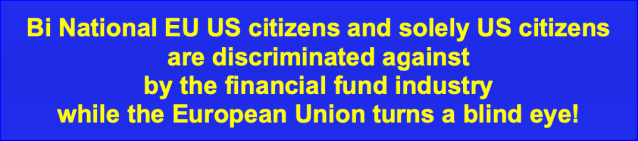
European FATCA petition against discrimination by financial institutions

A group of people residing in the European Union, with (also) the American nationality, in July has started a European petition against discrimination by financial institutions:

The aim of this petition

To ask the European Parliament and the Council as is their right to order ESMA to investigate the 11 National Competent Authorities of Luxembourg, Ireland, Germany, the Netherlands, France, Belgium, Austria, Sweden, Italy, Spain, and Denmark that allow discrimination on the basis of nationality in EU regulated financial documents namely Key Information Documents, Prospectuses, Marketing material and Websites. Those documents are entirely regulated by many directives and regulations that constitute the legal framework of the Capital Markets Union also known as passporting.

Discrimination in such documents is a gross breach of Article 21.2 of the Charter of Fundamental Rights and article 18 of the Treaty of the Functioning of the European Union.

We are making available 1300 such discriminating documents by major European, British and American asset management companies for PETI, JURI, LIBE, MEPs, the Commission should they be interested, the public and journalists to see.

In addition there is the grave question of EU citizenship and its legal implications within the EU. The fact that due to FATCA IGAs Member States’ governments and EU financial institutions exchange the data of dual EU US citizens with a non Member State raises the fundamental question of European citizenship as bi nationals are now considered US citizens by Member States’ governments and EU financial institutions alike.

Since the Micheletti case, governments must grant or retrieve nationality “with due regard of Community law”.

“Logically the Micheletti decision must also apply when signing treaties or IGAs such as FATCA through which we partially lost our EU citizenship through Member States’ governments actions and entirely our EU citizenship for financial institutions who consider now us US citizens.”

The fact that:

1. FATCA IGAs are bilateral agreements,
2. the Commission has no mandate to negotiate with the US from Member States and
3. there is such a thing as the Payment Account Directive

are totally irrelevant issues against the legal arguments raised in this petition.

On the site more explanation is to be found:


More information:

Geplaatst in Belastingrecht, English - posts in English on this blog, Europa, Financieel recht, onder meer Wft, Wtt, Grondrechten | Tags: , , , , , | Plaats een reactie

BSN-gebruik door het Centraal bureau voor de statistiek

De binnen de overheid aangewezen instellingen die het burgerservicenummer (BSN) mogen gebruiken, liggen redelijk voor de hand. Een zeer raadselachtige BSN-gebruiker is het Centraal bureau voor de statistiek (CBS). In de op het CBS betrekking hebbende Wet op het Centraal bureau voor de statistiek staat in artikel 34:

De directeur-generaal kan het burgerservicenummer opnemen in een registratie en daarvan gebruik maken ten behoeve van statistische doeleinden. De directeur-generaal kan het burgerservicenummer gebruiken in contacten met personen en instanties voor zover deze zelf gemachtigd zijn tot het gebruik van dat nummer in een registratie.

Ik kan me geen statistisch doeleind voorstellen waar een BSN voor nodig is. Ook de memorie van toelichting levert geen verheldering op.

Is er een lezer die dit raadsel kan ophelderen?


NB Overigens was er sprake van een plan om telco’s te verplichten telecomgegevens aan het CBS te verstrekken ten behoeve van corona-analyse, zie dit artikel. Het daarin beschreven nieuwe artikel 14.7 Telecommunicatiewet is er nog niet. Het geeft aan dat men denkt aan een rol van CBS bij het monitoren van de burgers.


Aanvulling 13 augustus 2021
Het CBS laat weten dat datasets gekoppeld worden via het BSN en verwijst naar deze pagina.
Privacy First meldde er al een keer aandacht aan te hebben besteed en vernomen te hebben dat dataverzoeken van AIVD, OM, politie en dergelijke altijd te hebben afgewezen.

Het neemt niet weg dat de overgang naar een surveillance instantie mogelijk makkelijk te realiseren is en dat is een risico.


Aanvulling 16 augustus 2023
Het CBS verwerkt wel degelijk persoonsgegevens, zie de berichten over de microdata leveringen door het CBS. Het is onderzoek waard.

Geplaatst in Bestuursrecht, ICT, privacy, e-commerce | Tags: , , , , , , , | Plaats een reactie

Hoe zat het ook al weer met het burgerservicenummer (BSN)? | renseignering

Een van de pijnpunten – als mensen zich bij private partijen zoals banken moeten identificeren en is toegelaten dat er een kopie van het identiteitsbewijs wordt gemaakt – is het burgerservicenummer (BSN). Dat BSN mag worden afgedekt als de onderneming geen wettelijke plicht heeft het BSN te gebruiken.

Het BSN mag alleen door overheidsinstanties worden gebruikt voor in de wet aangegeven doelen, zo is ook in de toelichting door de Autoriteit Persoonsgegevens (AP) te vinden. Over private partijen (zoals banken en ondernemers in de zorg) schrijft de AP niet meer dan dat het gebruik door die partijen op de wet gebaseerd moet zijn. Een duidelijke lijst van instellingen en wat ze mogen trof ik op de site van de AP niet aan.

Wwft en BSN

Voor de identificatieplicht uit de Wwft mag de bank, verzekeraar of creditcardmaatschappij het BSN niet verwerken. Ook met een kopie van het identiteitsbewijs zonder BSN kunnen financiële ondernemingen namelijk aantonen dat ze aan de identificatieplicht uit de Wwft voldoen. Aldus de AP.

BSN gebruik in de financiële sector

In de financiële sector mag een organisatie het BSN alleen in specifieke op de wet gebaseerde gevallen registreren en gebruiken, onder meer:

  • Banken zijn in de Wet inkomstenbelasting 2001 aangewezen als één van de partijen die gegevens aan de Belastingdienst moet leveren ten behoeve van de belastingheffing (renseignering). Daarbij dient de bank het BSN te vermelden van degene op wie de gegevens en inlichtingen betrekking hebben. Zie hier onder nader.
  • Als het depositogarantiestelsel op een rekening van toepassing is, voert een bank een administratie, waarbij gebruik wordt gemaakt van het BSN van de depositohouder, aldus artikel 3:17 Wet op het financieel toezicht.
  • Bij de uitwisseling van gegevens tussen overheid en banken en betaaldienstverleners door middel van het verwijzingsportaal bankgegevens, wordt van het BSN gebruik gemaakt, aldus artikel 3:267i Wet op het financieel toezicht.
  • Financiële ondernemingen die ingevolge de Wet op het financieel toezicht in Nederland het bedrijf van bank mogen uitoefenen zijn gehouden aan de Belastingdienst kosteloos de volgende gegevens inzake bankrekeningen te verstrekken: het bankrekeningnummer en de naam, het adres en de geboortedatum van de houder van de bankrekening, alles voor zover die gegevens van belang zijn voor de uitbetaling van inkomstenbelasting of het afboeken van een door de ontvanger ontvangen betaling op een in te vorderen bedrag. De Belastingdienst kan bepalen dat het BSN wordt verstrekt. Aldus artikel 62bis Invorderingswet 1990.
  • De verplichting tot het gebruik van het burgerservicenummer geldt volgens artikel 1 van de Uitvoeringsregeling verplicht gebruik BSN (gebaseerd op de AWR) voor de betaaldienstverlener bij de uitvoering van de regels die van belang zijn voor voldoening aan de betalingsvordering, bedoeld in hoofdstuk IA van de Uitvoeringsregeling Invorderingswet 1990. Dit lijkt te gaan over incasso van overheidsvorderingen.

Renseignering

Op grond van de Wet inkomstenbelasting 2001 (Wet IB), mede gebaseerd op de Algemene wet inzake rijksbelastingen (AWR), is een groot aantal ondernemingen aangewezen, die gegevens aan de Belastingdienst moeten leveren ten behoeve van de belastingheffing. Zij worden in het uitvoeringsbesluit als ‘administratieplichtigen’ aangeduid en moeten het BSN gebruiken bij de gegevensuitwisseling met de Belastingdienst.

In de per 1 januari 2021 geldende tekst zijn dat:

    • banken [*],
    • beheerders [*],
    • beleggingsinstellingen [*],
    • beleggingsondernemingen [*],
    • betaaldienstverleners [*],
    • elektronischgeldinstellingen [*],
    • financiële instellingen [*], in de Wft gedefinieerd als “financiële instelling als bedoeld in artikel 4, eerste lid, onderdeel 26, van de verordening kapitaalvereisten“, waaronder een grote variëteit van ondernemingen valt, onder meer leningverstrekkers, financiële leasing, betalingsdiensten, vermogensbeheerders en verhuurders van safes.
    • levensverzekeraars [*],
    • natura-uitvaartverzekeraars [*],
    • schadeverzekeraars [*],
    • pensioenuitvoerders in de zin van artikel 1 van de Pensioenwet,
    • pensioenuitvoerders in de zin van artikel 1 van de Wet verplichte beroepspensioenregeling en de Stichting Notarieel Pensioenfonds, bedoeld in artikel 113a van de Wet op het notarisambt.

[*] In de zin van de Wet op het financieel toezicht.

De gegevensverstrekking van deze administratieplichtigen heeft  op dit moment betrekking op:

  • betaalproducten, spaarproducten en beleggingsproducten (te verstrekken gegevens onder meer waarde in het economisch verkeer aan het begin van het kalenderjaar, genoten rente);
  • schulden (te verstrekken gegevens onder meer waarde schuld einde boekjaar, rente, resterende maximale looptijd);
  • kapitaalverzekeringen;
  • spaarrekeningen eigen woning en beleggingsrechten eigen woning;
  • lijfrenten;
  • lijfrenterekeningen en lijfrentebeleggingsrechten;
  • recht als bedoeld in artikel 5.10, onderdeel a, van de Wet IB;
  • rechten op kapitaaluitkering uit levensverzekeringen;
  • aanspraken op periodieke uitkeringen of verstrekkingen;
  • premies als bedoeld in artikel 3.18 Wet IB;
  • bepaalde nettolijfrenten en nettopensioenen.

Het geeft aan hoe omvangrijk de dienstverlening van de financiële sector aan de overheid is.

De renseigneringsplicht wordt periodiek uitgebreid. Zo is het de bedoeling dat opdrachtgevers die inhoudingsplichtig zijn op grond van de Wet op de loonbelasting 1964 en collectieve beheersorganisaties met ingang van 1 januari 2022 aan de fiscus opgave gaan doen van nevenverdiensten (“uitbetalingen voor werkzaamheden en diensten die in de inkomstenbelasting doorgaans zullen behoren tot het belastbare resultaat uit overige werkzaamheden“). Nadere informatie staat in een wijzigingsbesluit van 7 juli 2021.

Eerder schreef ik op dit blog over Europese renseigneringsplannen voor platforms.

Tot slot

Als een onderneming om een BSN vraagt, is altijd goed om na te kijken of het type onderneming in een van bovenstaande categorieën valt. Als de onderneming niet genoemd wordt, is er aanleiding om te vragen om de wetsbepaling en de uitvoeringsregeling waarop het BSN-gebruik is gebaseerd.

Geplaatst in Belastingrecht, Financieel recht, onder meer Wft, Wtt, Fraude, witwasbestrijding, Wwft, Grondrechten, ICT, privacy, e-commerce | Tags: , , , , , , , , , , , , , , , | Plaats een reactie

Zelfs de V.S. krijgt een ubo-register – maar wel beperkter dan in de EU

Het schijnt er nu echt te komen, dat Amerikaanse ubo-register. Er is een Anti-Money Laundering Act of 2020 (‘the AML Act’) aangenomen waarin een Corporate Transparency Act (‘CTA’) is opgenomen. Zie over het Amerikaanse ubo-register het Harvard Law School artikel (februari 2021). Verder een FinCEN-bericht van 1 april 2021, FinCEN Launches Regulatory Process for New Beneficial Ownership Reporting Requirement en het Harvard Law School artikel daarover.

Verder kwam ik een ‘advance notice of proposed rulemaking’ (‘ANPRM’) van FinCEN tegen, aankondiging 4 mei 2021, document (pdf). De ubo-definitie luidt hier:

an individual who, directly or indirectly, through any contract, arrangement, understanding, relationship, or otherwise (i) exercises substantial control over the entity, or (ii) owns or controls not less than 25 percent of the ownership interests of the entity

en er zijn uitzonderingen, zie noot 31:

The definition contains certain exceptions, including, under certain circumstances: (i) Minors whose parent or guardian file their own beneficial ownership information; (ii) individuals who act as nominees, intermediaries, custodians, or agents; (iii) individuals acting solely as employees of an entity; (iv) individuals with interests through rights of inheritance; and (v) individuals who are creditors.

Dit is een duidelijk andere definitie dan die door de EU wordt gehanteerd.

Volgens GTAI beperkt het Amerikaanse register zich tot bepaalde typen rechtspersonen (“corporation, limited liability company” en vergelijkbaar) die geen reële aanwezigheid in de VS hebben ( “foreign-owned shell companies”), wat de VS een aantrekkelijk alternatief voor de EU maakt voor daar reëel aanwezige ondernemingen (in de EU geldt de ubo-register plicht voor veel meer soorten entiteiten en is er geen uitzondering voor reëel aanwezige ondernemingen).


Eerder bericht op dit blog over het Amerikaanse ubo-register: hier.

Geplaatst in Financieel recht, onder meer Wft, Wtt, Fraude, witwasbestrijding, Wwft, Grondrechten, Ubo-register | Tags: , , | Plaats een reactie

“Bankdiensten minder toegankelijk voor kwetsbaren” | MOB-onderzoek door DNB

Onder de titel “Bankdiensten minder toegankelijk voor kwetsbaren” verscheen een artikel bij de NOS naar aanleiding van een onderzoek door DNB op verzoek van het Maatschappelijk Overleg Betalingsverkeer (MOB). Het geeft aan hoe zorgelijk de situatie rondom de betaaldienstverlening is als gevolg van de digitalisering, het afnemend aantal geldautomaten en het afnemend aantal bankkantoren. Op de site van DNB verscheen het bericht Toegankelijkheid van betaaldiensten voor kwetsbare groepen achteruit.

Van deze ontwikkeling is een grote groep Nederlanders, zo’n één tot twee miljoen personen, de dupe.

Volgens het DNB-bericht zou deze negatieve trend als volgt gekeerd kunnen worden:

Om de negatieve trend voor kwetsbare groepen te keren, heeft het MOB in mei 2021 een actieplan opgesteld. Dat kent drie onderdelen. Ten eerste het beter informeren van mensen uit kwetsbare groepen over initiatieven van banken om de toegankelijkheid te verbeteren. Ten tweede het verbeteren van de persoonlijke aandacht op lokaal niveau – waar daar behoefte aan is – eventueel door servicepunten op te richten op plekken waar bankkantoren zijn verdwenen. Ook het opstellen van een stappenplan voor de sluiting van bankkantoren is hier onderdeel van. Ten derde het in samenwerking met maatschappelijke organisaties inventariseren van de precieze behoeften van kwetsbare groepen en het bedenken van oplossingen om aan die behoeften tegemoet te komen.

Meer informatie staat in de bereikbaarheidsmonitor 2021.

In de monitor is niet terug te vinden dat toegang tot het betaalverkeer voor iedereen met een FATCA ‘geur’ problematisch is geworden, daar schreef ik al eerder over.

Alarmbellen
Tel daar nog de problematische omgang van de banken met het cliëntenonderzoek op grond van de Wwft bij op, met de de-risking die grootschalig plaats vindt. Het zou politieke alarmbellen moeten laten rinkelen.


Aanvulling 16 augustus 2021
België geeft het goede voorbeeld als het gaat om digitale vaardigheden: Belgische banken komen met universele bankdienst voor niet-digitale klanten.

Geplaatst in Bankrekening krijgen en behouden, Financieel recht, onder meer Wft, Wtt, Fraude, witwasbestrijding, Wwft | Tags: , , , , , , , , , | 1 reactie

EU consultation on EU rules on public-private partnerships (PPPs) in AML/CFT

The European Commission started an internet consultation on EU rules on public-private partnerships (PPPs) in the area of the prevention of money laundering (AML) and terrorist financing (CFT).

The subject of the consultation is described as follows:

The objective of the consultation will be to collect additional relevant evidence in the form of views and opinions supported, to the extent possible, by facts and figures. The consultation aims to obtain information with regard to, for example, the types of public-private partnerships currently operating in the EU Member States in the area of preventing and fighting money laundering and terrorist financing, the public authorities (e.g. FIUs, law enforcement, supervisory authorities) and private sector entities which participate, the types of information exchanged within those partnerships and the measures put in place to guarantee the preservation of fundamental rights. The consultation would also aim to gather input with regard to the mechanisms put in place to measure the effectiveness and success of those partnerships (e.g. key performance indicators (KPIs) or any other performance metrics) and to improve the Commission’s understanding of the impacts, benefits and added value of the various public-private partnerships in the fight against money laundering and the financing of terrorism. The call for evidence would also provide an opportunity for the various public authorities and private entities, which take part in public-private partnerships, to explain and elaborate on the challenges faced and what do they pertain to.
The ultimate objective of the consultation is to provide the Commission with sufficient information and evidence for the purposes of preparing the guidance on the rules applicable to the use of public private partnerships in the framework of preventing and fighting money laundering and terrorist financing and issue best practices.

The target audience:

All citizens and organisations are welcome to contribute to this consultation. Views are in particular welcome from Member States, national and EU competent authorities, as well as businesses and service providers that are subject to anti-money laundering and countering the financing of terrorism rules. Civil society (NGOs, specialised policy organisations, think tanks), university and/or academic institutions are also target groups of this consultation.

The consultation closes 2 November 2021 midnight Brussels time.


More information:


Addition 11 January 2022
The European Banking Federation (EBF) responded to Public Consultation on Guidance on the Rules Applicable to the Use of Public-Private Partnerships in The Framework of Preventing and Fighting Money Laundering and Terrorist Financing, read their article and read their response. Banks ask for these partnerships, as they want more information to enable them to do their crimefighting tasks better, from the article:

At present, obliged entities send large numbers of SARs to FIUs with no or insufficient quantitative feedback. This situation does not allow obliged entities to focus on the most relevant predicate offenses and leads to an increased number of false positives. Often finding the relevant information for law enforcement authorities may feel like finding a needle in a haystack. If an intelligence-led approach were applied in the AML/CFT framework, obliged entities could receive information on current trends and typologies, as well as operational data which would allow them to focus their efforts on priorities as defined by law enforcement authorities. As a result, obliged entities would be able to send back more actionable data and do it in a smarter and aligned with data minimisation requirements way, reporting information when truly necessary.

The complex nature of money laundering and terrorism financing, often involving cross-border flows of funds and the involvement of many layers of entities, makes it challenging to detect such crimes when the data available to do so is mainly limited to a regulated entity’s own customer base and available open-source intelligence. Being able to enrich this view with information from other private sector entities and competent authorities enhances the likelihood of effective detection for all parties involved in a public-private partnership. It also allows both obliged entities and public authorities to form a holistic overall view of the current trends.

Geplaatst in English - posts in English on this blog, Europa, Financieel recht, onder meer Wft, Wtt, Fraude, witwasbestrijding, Wwft, Grondrechten | Tags: , , , , , | Plaats een reactie

Not-for-profit organisations and civic society threatened by governments | ECNL

Recent articles by the European Center for Not-for-profit Law (ECNL) show  the threats to not-for-profit organisations and civic society caused by legislation intended to combat crime (including anti-money laundering, ‘AML’, and combatting terrorist financing, ‘CFT):


Addition 10 August 2021
Special Report: How a little-known G7 task force unwittingly helps governments target critics, Reuters, in the article:

The FATF, in emailed responses to Reuters’ questions, said it was aware of reports its recommendations have been misused and was monitoring governments’ oversight of nonprofits. It said this year it established a working group on the “unintended consequences of poorly implemented” measures and was identifying possible options to mitigate them.

Geplaatst in English - posts in English on this blog, Financieel recht, onder meer Wft, Wtt, Fraude, witwasbestrijding, Wwft, Grondrechten | Tags: , , , , , , , , | Plaats een reactie

Transparency of donors in the Netherlands | ECNL, AML / CFT

Legislative intentions regarding transparency of donors to not-for-profit organizations has caught the attention of the European Center for Not-for-profit Law (ECNL).

On 29 June ECNL published the article New proposed changes to the Dutch Transparency Act, an update on the most important improvement and remaining concerns of the revised draft:

New proposed changes to the Dutch Transparency Act

29-06-2021
Short update on what the most important improvements and remaining concerns are in the revised draft.


After a strong public reaction to the previous draft of the Dutch Transparency Act and parliamentary questions at the end of 2020, the Ministry of Justice and Security has just published a revised draft for a second round of public consultation on June 8, 2021.

What has happened so far?

The very first draft of the Act in late 2018 required all civil society organisations (CSOs) to publish overviews of donations that amount to or exceed 15,000 EUR a year.

Read ECNL’s first comment to the first draft here.

After a strong push back by civil society in 2019, the Ministry took a different framing and approach in November 2020 by replacing this generic obligation for all CSOs with narrowing the focus of interest to CSOs that are considered a (potential) threat to ‘public order’ or ‘general interest’.

ECNL had identified main points of why the second draft Act in 2020 was not in line with European and international standards, read it here.

We now analyze the main changes proposed in the third draft from June 2021 compared to the previous version from November 2020, and assess to what extent these have improved the standards and what the remaining concerns are.

Relevant changes that improve the previous version of the draft Act

No discrimination based on origin donor: Potentially unwanted donations now also include those from the Netherlands and within the EU/EEA (previously, only donations from outside the EU/EEA were deemed as potentially suspicious). This broadens the number and scope of donations under potential scrutiny, but does not discriminate based on the origin of the donor.

Clear possible follow-up actions and judicial oversight: The amendment clarifies which authorities can take follow-up actions after gathering information on donations and donors from CSOs that are under scrutiny for activities that may ‘undermine democratic rule of law’. More specifically, it is now only up to the Public Prosecutor to determine whether and, if so, what follow-up action will be taken. The Public Prosecutor can now request the Court to order one or more measures if it is plausible that a CSO receives donations and carries activities that undermine or are aimed at undermining the democratic rule of law. The measures introduced are:

  1. an order to periodically report all or specified categories of donations to the public prosecutor’s office for a period of up to three years to be determined by the court;
  2. the freezing of one or more goods for a maximum period of one year, which can be renewed if requested by the Public Prosecutor;
  3. a ban of up to two years from receiving certain donations or certain specified categories of donations;
  4. the return of donations, the deposit in a third-party money account designated by the court or the forfeiture to the state of certain donations or goods.

Assessment framework for the Court: The new draft introduces criteria and assessment framework related to what constitutes “undermining of the democratic rule of law” and which (type of) activities could fall under this.  The judge will weigh up, among other things, the seriousness and nature of the conduct and the nature and seriousness of the consequences for the ‘democratic rule of law’.

It is positive that the draft Act introduces clearer criteria for what constitutes “undermining the democratic rule of law” and that it embeds some constitutional guarantees, including judicial overview at a later stage. However, there are still some relevant points that are not in line with European and international standards.

Remaining concerns

Lack of oversight for far-reaching powers for the Mayor: The Mayor is still given far-reaching powers with a large margin of appreciation without any (parliamentary) oversight for demanding information from CSOs about their donations and donors when it deems a (potential) threat to the democratic order. For example, the Mayor can impose a penalty payment for each day the CSO fails to provide the requested information (duty to cooperate). The Mayor can also request the Court to impose an administrative ban on the CSO director if they fail to fulfil their information or cooperation obligations imposed by this draft. In this regard, the draft Act is still not in line with rule of law principles.

Legal uncertainty: The large margin of appreciation of the Mayor to assess whether or not a CSO and their activities are or will potentially be a threat to public order (and thereby undermine democratic rule of law) also creates legal uncertainty as there are no clear criteria on what may constitute an indication of risk or disruption of ‘public order’ that can trigger these powers of the Mayor. This gives room for discriminatory application as it will be left to the whim of the Mayor and can potentially lead to self-censorship of CSOs and limiting Freedom of Expression and Freedom of Association and Assembly  as CSOS and activists may feel that they might be under additional scrutiny for what they do and say.

Lack of a clear remedy:   CSOs do not have clear legal remedies to contest the decision of the authorities when, for example the Mayor, demands information on their donations and donors. CSOs will not be able to know based on what activities the Mayor concluded that they are a potential risk and need further scrutiny and will also have no opportunity to proof otherwise. This would result in a practice contrary to the rule of law principles.

Violation of the right to privacy: the draft Act requests all intermediaries to obtain private information in advance about the donors of CSOs (name, private residency/seat, country) regardless if there is justified reason for further scrutiny by the Mayor and other authorities. This puts burden on CSOs to obtain and verify information, regardless of being scrutinised or not. At the same time this may deter individual donors to provide funding because they may not be willing to provide private information and data without clarity how it will be used in future proceedings. Legitimate donors might be reluctant or not able (for legal reasons) to share their privacy protected details and therefore decide not to donate to Dutch CSOs, creating vacuum of income for many organizations.

A wide group of CSOs will still be potentially affected: the draft Act does not provide clear criteria that will guide the authorities to decide whether or not to demand information on donations and donors. This means that a large group of CSOs receiving funding will potentially be subject to additional administrative requirements, supervision and potential restrictions to their activities. This is especially the case for the Mayor and in relation to what constitutes a potential threat to ‘public order’.

Disproportionate infringement on freedom of religion and belief: The Mayor is still enabled to process personal data which may show religious or philosophical believes (article 3(2)). It is not explained why it is necessary to gather this particular data to determine whether or not an organisation is a threat to public order and/or democratic rule of law. Even if argued to be necessary, it is important to demarcate clearly what specific information is allowed to gather as the current formulation is too broad. This means that a broad interpretation can lead to disproportionate infringement on the freedom of religion and beliefs. It can also disproportionately affect certain religious minority groups and thereby be discriminatory.

In conclusion, the points made above make it evident that the draft Act still has a number of important concerns and issues that should be taken into consideration in the follow-up of the public consultation.

Read ECNL’s contribution – written jointly with other Dutch CSOs – to the public consultation below (in Dutch):

Joint submission on the Dutch Transparency Act June 2021


Action for Civic Space / Netherlands

 

More information:

ECNL on the draft legislation:

Geplaatst in English - posts in English on this blog, Financieel recht, onder meer Wft, Wtt, Fraude, witwasbestrijding, Wwft, Grondrechten, ICT, privacy, e-commerce, Not-for-profit, Stichting en vereniging | Tags: , , , | Plaats een reactie