Responsible private funding of litigation

In March 2021 the think tank of the European Parliament published a study on third party litigation funding (‘TPLF’).
In June of the same year a draft report for the Committee on Legal Affairs (JURI) with recommendations to the Commission on Responsible private funding of litigation was made public. The report contains a a motion for a European Parliament resolution, stating that TPLF may cause problems and that further regulation through a directive is necessary. From the draft motion:

Introduction
1. Observes that third party litigation funding is a rapidly expanding commercial practice in the Union, which has a significant impact on justice systems as well as on European citizens. Notes that litigation funding is so far largely unregulated in the Union;
2. Firmly believes that in order to ensure that justice systems prioritise redress for victims of injustice, and not the interests of investors who may seek commercial opportunity from disputes, a regulatory regime addressing key issues relevant to litigation funding, including transparency, fairness, and proportionality, is necessary;
3. Strongly believes that only the regulation of litigation funders will allow regulators to exercise effective oversight and adequately ensure that the interests of claimants are protected. Points out that voluntary regulatory mechanisms and codes of conduct have not been subscribed to by the large majority of funders, leaving claimants significantly exposed;

Regulation and supervision of litigation funders
4. Recommends the establishment of a system of authorisation for litigation funders, permitting the introduction of corporate governance requirements and supervisory powers to protect claimants, and to ensure that funding is only provided by entities that are committed to complying with minimum standards in terms of transparency, governance and capital adequacy, and observing a fiduciary relationship vis-à-vis claimants and intended beneficiaries;

Ethical issues
5. Recommends that litigation funders be obliged to respect a fiduciary duty of care requiring them to act in the best interests of a claimant. Believes that litigation funders should be prevented from exercising control over the legal proceedings they fund, which should be the sole responsibility of the claimant and their legal representatives. Points out that such control over the legal proceedings they fund can consist both of formal control, such as a contractual power to make decisions, and informal control, such as the threat to withdraw the funding;
6. Underlines that conflicts of interest may arise where there are relationships between litigation funders, qualified entities, law firms, aggregators, including claims-collection and award-distribution-platforms, and other actors who may be involved in claims. Notes that there is a trend of an increasingly close cooperation, with, for example, litigation funders agreeing to finance law firms across a series of future cases (portfolio funding) [7]. Recommends that safeguards are adopted to prevent such conflicts, set out claimants’ rights and to require that details of relationships between litigation funders and the other involved parties are disclosed;
7. Believes that litigation funders should not be permitted to abandon funded parties in litigation, except in restricted and well-defined circumstances, leaving claimants solely responsible for all costs of the litigation, which may have only been pursued due to the involvement of the funder;
8. Believes that, just like claimants, litigation funders should be responsible for the defendants’ costs arising from unsuccessful litigation (such as an adverse cost award). Is of the opinion that regulation should prevent litigation funders from limiting their liability to costs in the event of an unsuccessful outcome;

Incentives and limits on recovery
9. Considers that legislation should impose limits on the proportion of the award that litigation funders are entitled to by virtue of a funding agreement. Believes that only under exceptional circumstances arrangements between litigation funders and claimants should vary from the rule that a minimum of 60% of the gross settlement or damages is paid to the claimants;

Disclosure and transparency
10. Considers that there should be transparency regarding the involvement of litigation funding in legal proceedings, including obligations for claimants and their lawyers to disclose funding agreements to courts and defendants. Notes that, currently, courts or administrative authorities and defendants are often not aware that a claim is funded by a commercial actor. Points out that this can also hinder a court or administrative authority in properly considering costs issues and in ensuring that awards compensate claimants adequately;

Powers of supervisory authorities and review by courts and administrative authorities
11. Is of the opinion that supervisory authorities, and courts and administrative authorities were appropriate in accordance with national procedural law, should have the powers to facilitate the enforcement of legislation adopted to achieve the goals set out above; recommends the establishment of a complaints system. Considers that supervisory authorities, and courts and administrative authorities where appropriate in accordance with national procedural law, should have the powers to address abusive practices by authorised litigation funders;

Final aspects
12. Requests the Commission to submit a proposal for a directive to regulate third party litigation funding, following the recommendations set out in the Annex hereto;
13. Considers that the requested proposal will not have financial implications;
14. Instructs its President to forward this resolution and the accompanying recommendations to the Commission and the Council;

[7] EPRS Study (2021): Responsible litigation funding. State of play on the EU private litigation funding landscape and on the current EU rules applicable to private litigation funding, p. 28 -29.

In an annex to the draft-report there is a proposal for a directive. According to article 4 Member States may determine in accordance with national law whether third party funding agreements can be offered in relation to proceedings within their Member State, or for the benefit of claimants or intended beneficiaries resident within their Member State. Where such activities are permitted, Member States shall create a system for the authorisation of the activities of litigation funders.

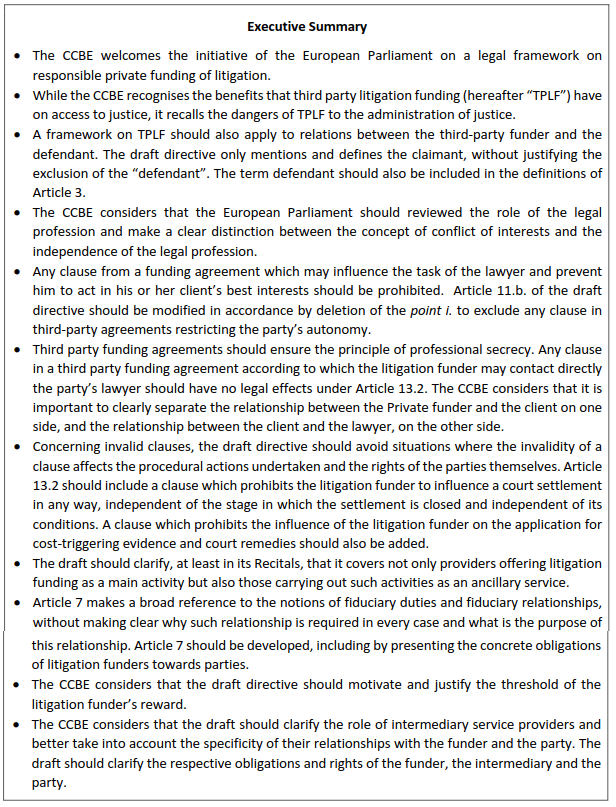
I do not know whether there has been a European consultation, but I see that a number of parties have responded to the draft report. Among them are the Council of Bars and Law Societies of Europe (CCBE) and a group of representatives of large companies, including the European Banking Federation (EBF).

The large companies are worried, read the article on the EBF-site:

The introduction of a profit-motivated third party into the traditional attorney-client relationship presents a host of ethical issues and other public policy considerations. Funders may prioritize their bottom-line interests over the interests of the claimants and can unduly influence the decisions in a case. Funders can also arrange to be paid first and take a disproportionate share of any award, leaving claimants who suffered harm with little or no redress. (…)
We are therefore supportive of the European Parliament’s legislative own-initiative report on responsible private funding of litigation, which calls on the European Commission to propose sensible safeguards for effective oversight of TPLF in all areas of law and types of litigation.

It is interesting to see that JURI proposes to regulate this economic activity and that there is no European activity regarding data brokers providing services to financial institutions and obliged entities under AML/CFT rules.


More information:

Europe:

Comments:

Geplaatst in English - posts in English on this blog, Europa, Grondrechten, Not-for-profit, Procesrecht, rechtspraak | Tags: , , , , | Plaats een reactie

The report of the UN Special Rapporteur on the independence of lawyers | CCBE

The independence of judges and lawyers is threatened, also in the western world. CCBE in its latest newsletter reports on participating in the 50th UN Human Rights Council in Geneva where the UN Special Rapporteur on the Independence of Judges and Lawyers, Diego García-Sayán, presented his report on the “Protection of lawyers against undue interference in the free and independent exercise of the legal profession”. CCBE summarizes the report as follows:

The Special Rapporteur recommends, among others, that States should take all necessary measures to ensure the free exercise of the legal profession, in all circumstances, so that lawyers may exercise their legitimate professional rights and duties without fear of reprisals and free from all restrictions, including judicial harassment. In particular, the Special Rapporteur made a recommendation that States should design and carry out measures to prevent the identification of lawyers with their clients or the causes they defend. Additionally, the Special Rapport stresses the importance for Bars and Law Societies to remain independent and self-governing professional associations in order to promote and protect the independence and the integrity of lawyers as well as to safeguard their professional interests.

Most importantly, as regards the ongoing work of the Council of Europe on the drafting of an international legal instrument aimed at strengthening the protection of the legal profession and the right to practise law freely without prejudice or hindrance, the Special Rapporteur supports the adoption of a binding instrument that is open to accession by non-member States of the Council of Europe. In its concluding remarks to the UN Human Rights Council, the Special Rapporteur particularly underlined his gratitude to the CCBE for its collaboration and contribution to the preparation of the report, praising its work for the “defence of defenders”. He ended by appealing again to the Council of Europe Member States to support the adoption of a binding legal instrument on the protection of the free and independent exercise of the legal profession that is open to accession by non-member States of the Council of Europe.


More information:

Earlier articles on this blog:

Geplaatst in Dienstverlening - juridisch financieel [advocaten, accountants, belastingadviseurs e.d.], English - posts in English on this blog, Europa | Tags: | Plaats een reactie

OECD and lawyers as ‘enablers’ of crime | CCBE

The Economic Cooperation and Development (OECD) is one of the organisations that claims that all lawyers are ‘enablers’ of crime. The Council of Bars and Law Societies of Europe (CCBE) in it’s July July newsletter wrote it was invited to a meeting with the Organisation for Economic Cooperation and Development (OECD) Task Force on Tax Crimes and Other Crimes. CCBE said:

During a session entitled “The role of professional associations in fighting professional enablers”, the CCBE had the opportunity to present what professional associations do in the field of prevention, and any work and measures put in place that aim to tackle crime by professionals. The meeting was also an opportunity to engage in a constructive exchange with the OECD.

It looks as if discussion only covered crimes ‘by’ professionals, whereas nowadays the impossible is expected from entrepreneurs (such as lawyers) to prevent crime. Hopefully, a proper distinction will be made between the deliberate involvement and the insufficient investigation to prevent unconscious involvement.

Geplaatst in Belastingrecht, Dienstverlening - juridisch financieel [advocaten, accountants, belastingadviseurs e.d.], English - posts in English on this blog, Europa, Financieel recht, onder meer Wft, Wtt, Fraude, witwasbestrijding, Wwft | Tags: , | Plaats een reactie

CCBE newsletter with Ukraine focus

In July the Council of Bars and Law Societies of Europe (CCBE) published a newsletter with focus on Ukraine. The newsletter covers themes like supporting the legal professionals in the country (special webpage), the European measures (e.g. the Task Force on ‘Freeze and Seize’ and EU sanctions). On sanctions CCBE published a document (pdf).

Geplaatst in Dienstverlening - juridisch financieel [advocaten, accountants, belastingadviseurs e.d.], English - posts in English on this blog, Europa, Financieel recht, onder meer Wft, Wtt, Fraude, witwasbestrijding, Wwft, Grondrechten, Sanctieregels | Tags: | Plaats een reactie

Doxing verbod in het Wetboek van Strafrecht

Begin juli is het wetsvoorstel ingediend dat misbruik van persoonsgegevens voor intimiderende doeleinden (soms als ‘doxing’ aangeduid) strafbaar moet maken. De kern van het voorstel is een nieuw artikel:

Artikel 285d
Degene die zich persoonsgegevens van een ander of een derde verschaft, deze gegevens verspreidt of anderszins ter beschikking stelt met het oogmerk om die ander vrees aan te jagen dan wel aan te laten jagen, ernstige overlast aan te doen dan wel aan te laten doen of hem in de uitoefening van zijn ambt of beroep ernstig te hinderen dan wel ernstig te laten hinderen, wordt gestraft met gevangenisstraf van ten hoogste een jaar of geldboete van de derde categorie.

In de memorie van toelichting wordt het onderwerp van het voorstel als volgt ingeleid:

Het is betrekkelijk eenvoudig om via internetbronnen persoonlijke informatie van individuele personen te achterhalen. Enige basiskennis van het internet volstaat om via een zoekopdracht persoonsgegevens boven water te krijgen. De publieke toegankelijkheid van het internet en de bereikbaarheid van anderen door middel van sociale media bieden kwaadwillenden de mogelijkheid om deze persoonsgegevens te gebruiken om mensen vrees aan te (laten) jagen, ernstige overlast aan te (laten) doen of ernstig te (laten) hinderen in hun dagelijks leven. Dit kan leiden tot gedragingen die een dusdanige inbreuk op iemands persoonlijke levenssfeer maken dat deze gedragingen naar de huidige in de maatschappij levende opvattingen als uiterst onwenselijk en strafwaardig worden gezien. Een onwenselijke en strafwaardige gedraging is het zich verschaffen, verspreiden of anderszins ter beschikking stellen van persoonsgegevens voor intimiderende doeleinden, een gedraging die nauw aansluit bij dat wat wordt aangeduid als doxing (ook wel: doxxing).

Geconstateerd wordt dat het probleem door de digitale communicatiemogelijkheden steeds groter wordt en dat de slachtoffers worden geïntimideerd en zich niet meer veilig voelen in hun dagelijkse omgeving. Het kabinet kiest voor het stellen van een norm:

Hiermee wordt een duidelijke norm gesteld: het zich verschaffen, verspreiden of anderszins ter beschikking stellen van andermans persoonsgegevens met het doel een ander te intimideren (hierna ook: strafbare doxing) is onacceptabel en wordt onder de reikwijdte van de strafwet gebracht. Daarbij is niet van belang of de gedragingen al dan niet online plaatsvinden.

Dat ‘doel’ zal door de daders altijd worden ontkend, zodat de vraag is wat het praktische effect van deze strafbaarstelling gaat zijn.


Meer informatie:

Geplaatst in Grondrechten, ICT, privacy, e-commerce, Strafrecht | 1 reactie

Russenverbod trustkantoren in werking getreden

In aanvulling op de eerdere berichtgeving inzake het Russenverbod voor trustkantoren kan ik melden dat dit verbod in werking is getreden, de wet is in het Staatsblad verschenen.


Dit bericht verscheen eerder op de site van Compliance Platform Trustkantoren.

Geplaatst in Financieel recht, onder meer Wft, Wtt, Fraude, witwasbestrijding, Wwft, Sanctieregels, Trustkantoren | Plaats een reactie

Samenwerkingsverbanden Belastingdienst

Wie belangstelling heeft voor alle samenwerkingsverbanden die er in Nederland binnen de overheid bestaan, kan het ‘Organogram samenwerkingsverbanden Belastingdienst‘ bekijken, dat in het kader van de FSV-affaire aan de Tweede Kamer is gestuurd. Genoemd worden:

  • RIEC/LIEC
  • LSI
  • Manifestgroep
  • Inlichtingenbureau werk & inkomen

Als voorbeeld gaat hier onder RIEC/LIEC:


Deze organisatie komt voor in het artikel ‘Instanties delen onderling niet gecheckte informatie over Niel: “Ze hebben me alles afgenomen”‘, RTV Oost, 27 juni 2022.

Geplaatst in Belastingrecht, Financieel recht, onder meer Wft, Wtt, Fraude, witwasbestrijding, Wwft | Plaats een reactie

Bevrijd kinderen uit de digitale wurggreep | petitie

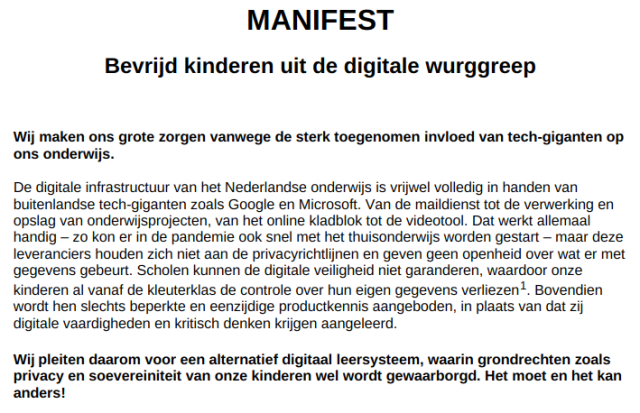
Onlangs is een petitie gestart onder de titel ‘Bevrijd kinderen uit de digitale wurggreep‘, waarin een coalitie van ouders, it’ers, docenten en privacy-voorvechters vraagt om een een ander beleid voor de digitale, online kanten van het onderwijs.
De petitie is gericht aan de Tweede Kamer en loopt tot 9 augustus 2022.

Het manifest begint met:

De petitie wordt gesteund door organisaties als Freedom Internet (artikel), Privacy First (artikel) en Waag:


Doe mee!

Geplaatst in Grondrechten, ICT, privacy, e-commerce | Tags: , , | 1 reactie

De slager van de NOvA

Volgens journalist Strop zouden de dekens van de Nederlandse Orde van Advocaten Houthoff hebben neergezet als “Het braafste jongetje van de klas“:


(ik kan me niet voorstellen dat het kantoor als braafste jongetje is neergezet, maar leuke framing).

In de titel van het artikel spreekt deze journalist over misleiding door de NOvA: “Orde van Advocaten misleidde minister over problemen bij Houthoff“, dat is nog al wat.


Er wordt geciteerd uit processtukken die kennelijk uit een tegen Houthoff gevoerde procedure komen. De vraag is of de mededelingen over de NOvA kloppen. Strop houdt geheim waarover en tegen wie Houthoff procedeerde, het lijkt geen procedure tegen (de deken van) de NOvA te zijn. Nu de citaten spreken over compliance, suggereert dit dat het een interne procedure is. Zou er een interne rel bij het advocatenkantoor zijn en zou er iemand bezig zijn met een wraakoefening? De NOvA heb ik er nog niet over gehoord.

Onafhankelijkheid advocatuur ten opzichte van de Staat
Gelukkig heeft Strop het in zijn artikel niet over slagers die eigen vlees keuren, maar hij laat ook niet blijken te weten waarom advocaten onafhankelijk van de overheid horen te zijn, want hij schrijft:

Als Weerwind meegaat met hun verzet, behouden advocaten hun uitzonderingspositie. Notarissen staan al vele jaren onder toezicht van het onafhankelijke Bureau Financieel Toezicht, geleid door professionals – niet door notarissen. Onafhankelijk toezicht is er ook op accountants, deurwaarders en bankiers.

Misschien dat iemand aan hem kan uitleggen dat het bij advocaten anders ligt…

Integriteitsregels voor advocaten
Dat neemt overigens niet weg dat advocaten en hun kantoren de integriteitsregelgeving serieus moeten nemen, dat betreft de Wet ter voorkoming van witwassen en financieren van terrorisme (Wwft) inzake Wwft-plichtige diensten en de integriteitsregels uit de Verordening op de advocatuur (Voda) voor alle overige diensten.


NB 1 Strop laat niet blijken veel van de advocatenregels te begrijpen. Over de Voda rept hij niet.
Hij schrijft over de Wwft “Daarom moeten ze in bepaalde gevallen de identiteit van hun cliënt vaststellen” (dat moeten advocaten altijd, ook als de Wwft niet van toepassing is) en zegt dat dit “ook wel know your customer (kyc) [wordt] genoemd” (klopt evenmin, een cliëntenonderzoek omvat meer dan verificatie van de identiteit).

NB 2 Op 15 juli jl. werden vragen uit de Tweede Kamer beantwoord over een eerder Follow the Money artikel van 22 juni jl. Uit het antwoord blijkt dat FtM het huiswerk niet goed heeft gedaan, want anders dan in het artikel werd verondersteld golden er destijds geen sancties voor Sberbank.

Geplaatst in Dienstverlening - juridisch financieel [advocaten, accountants, belastingadviseurs e.d.], Fraude, witwasbestrijding, Wwft, Grondrechten | Tags: , , , | Plaats een reactie

FATCA-letter of the French ministry of foreign affairs

Today the French association of Accidental Americans published the FATCA-letter of 20 July it received from the French ministry of foreign affairs, read the LinkedIn post by chairman Lehagre. The post:

📬 Réponse de la Ministre de l’Europe et des Affaires étrangères à mon récent courrier relatif à #FATCA et aux problèmes rencontrés par les Américains accidentels pour renoncer à la nationalité américaine.

🙄 Rien de neuf si ce n’est que le MAE reste mobilisé…

Machine translation of the post:

📬 Response from the Minister of Europe and Foreign Affairs to my recent letter regarding #FATCA and the problems faced by accidental Americans in renouncing US citizenship.

🙄 Nothing new except that the ministry of foreign affairs remains actively involved…

Machine translation of the letter:

In a letter dated 30 May 2022, you drew my attention to the fiscal and banking difficulties encountered by our Franco-American compatriots concerned by the US Foreign Account Tax Compliance Act (FATCA) of 2010.

As you point out, “accidental Americans”, French citizens who are also American nationals because they were born in the United States, are subject to obligations resulting from American fiscal legislation, even though they have no particular effective link with this country. The Government has for several years drawn the attention of the American authorities to their particular situation. Progress has been made, in particular by the introduction in September 2019 of a special amnesty procedure, which limits the obligation to pay US tax arrears for many dual nationals who decide to renounce their US nationality. In addition, the Internal Revenue Service’s (IRS) clarification in October 2019 of the obligations of financial institutions to collect the fiscal identity numbers of their US clients also helps to clarify the situation of ‘accidental Americans’.

After these initial advances, the French authorities continued their dialogue with the US administration to further facilitate the procedures for our Franco-American citizens, by involving our European partners who are also concerned by this issue. France has thus included this subject on the agenda of the Council of the European Union from 2021, so that the issue can be brought to the attention of the US administration in a coordinated manner by the Member States and the European institutions.

This work, which was widely supported by our European partners, was structured in the first quarter of 2022, under the French Presidency of the Council of the European Union. They aimed to propose concrete solutions to the IRS “with a view to clarifying the obligations incumbent on European financial institutions under the FATCA law, and to respond to the difficulty of ‘accidental Americans’ living in Europe. On 31 May, the French Presidency organised a meeting with the IRS, which considered the European proposal to be a good basis for discussion, although amendments would be necessary. The Czech Republic, which will take over the Presidency of the Council of the European Union in the second half of 2022, will continue to work on this issue with its European partners. The French authorities remain fully committed to this issue.

Thus, France, together with its European partners, has taken the initiative of an active dialogue with the US administration, with a view to resolving the difficulties you have mentioned. You may rest assured, Sir, that we are continuing this active dialogue in order to obtain decisive additional progress in favour of the “accidental Americans”.

As I said before: hopefully the U.S. starts to realize that their system of Citizenship Based Taxation is illegal and harming residents of other countries.


General information on this blog on FATCA and Citizenship Based Taxation:

Geplaatst in Bankrekening krijgen en behouden, Belastingrecht, English - posts in English on this blog, Europa, Financieel recht, onder meer Wft, Wtt, Fraude, witwasbestrijding, Wwft, Grondrechten | Tags: , , , , | Plaats een reactie