Antwoord op kamervragen over de ubo | Wwft, ubo-register

Onlangs werden weer eens kamervragen over het ubo-register beantwoord, waarin de Minister van Financiën opmerkt dat veel inschrijvingsplichtigen lang hebben gewacht met het inschrijven, waardoor een stuwmeer bij de Kamer van Koophandel is ontstaan.

Voorts wordt ingegaan op de nieuwe ubo-bureaucratie, over hoe ondernemingen die zich bezig moeten houden met criminaliteitsbestrijding (in de brief ‘meldplichtige instellingen’ genoemd) moeten omgaan met hun verplichting om een ubo-uittreksel in het dossier te hebben, vóór de werkzaamheden voor een nieuwe relatie worden aangevangen.

Ook komt wederom aan de orde dat meldplichtige instellingen niets aan het ubo-register hebben, al moeten ze wel een uittreksel opvragen. Zij moeten zelf checken wie de ubo is en als zij vinden dat de inschrijving niet klopt moeten zij een ‘terugmelding’ doen aan de Kamer van Koophandel.

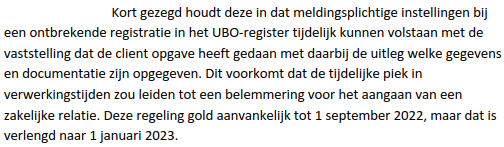
Er zijn overigens de nodige terugmeldingen te verwachten aangezien er meldplichtige instellingen zijn die een eigen Wwft hebben gecreëerd. Zo is er een bank die meent dat iemand met 25% van de aandelen ‘ubo’ is, terwijl in de 4e anti-witwasrichtlijn en het uitvoeringsbesluit staat dat het om een aandelen belang van meer dan 25%.

De Minister van Financiën heeft nog steeds een heilig geloof in het ubo-register en in het dubbele werk dat alle meldplichtige instellingen moeten doen.

Geplaatst in Financieel recht, onder meer Wft, Wtt, Fraude, witwasbestrijding, Wwft, Ubo-register | Tags: , , | Plaats een reactie

Wijziging WNT op komst

Op 7 september stuurde de voor de Wet Normering Topinkomens (WNT) verantwoordelijke minister, die van Binnenlandse Zaken en Koninkrijksrelaties (BZK), een brief aan de Tweede Kamer over in aantocht zijnde wijzigingen van de WNT. Het is verheugend dat de minister inziet dat deze wet onnodig ingewikkeld is en aanstuurt op vereenvoudiging.

De minister kondigt aan dat gewerkt wordt een verduidelijking van het bezoldigingsbegrip, de definitie van WNT-instelling en de definitie van ‘topfunctionaris’. Voorts is het de bedoeling dat er een wettelijke grondslag wordt gecreëerd om het controledossier bij de accountant op te vragen en de accountant de onderbouwing van de melding te laten mee sturen.

Geplaatst in Not-for-profit | Tags: | Plaats een reactie

Europe’s alternative social media pilot | EU Video & EU Voice

The European Data Protection Supervisor (EDPS) as part of an alternative social media pilot, started EU Video and EU Voice.

  • EU Video is the official ActivityPub video platform of the EU institutions, bodies and agencies (EUIs).
  • EU Voice is the official ActivityPub microblogging platform of the EUIs. It is part of the Mastodon system.


Geplaatst in English - posts in English on this blog, Europa, ICT, privacy, e-commerce | Tags: | Plaats een reactie

FATCA letter from the US Treasury to the Dutch ambassador | first comments by Lehagre and Richardson

On 29 August, 2022 the Assistant Secretary of Tax Policy, U.S. Department of the Treasury, Ms. Lily Batchelder, has sent a letter to the Dutch ambassador on FATCA with the following content:

I am writing regarding our ongoing discussions on the Foreign Account Tax Compliance Act (FATCA), during which you have requested further guidance with respect to Dutch financial institutions that are reporting information pursuant to the Agreement between the United States of America and the Kingdom of the Netherlands to Improve International Tax Compliance and to Implement FATCA (the IGA) regarding bank accounts of account holders that have not provided U.S. taxpayer identification numbers (U.S. TINs) to the financial institution. We understand that the issue is of particular concern with respect to bank account holders that are U.S. citizens who are residents of the Netherlands and have limited ties to the United States.

We value our collaboration with the Netherlands in countering offshore tax evasion and improving international tax compliance. We believe that it is in our mutual interest for U.S. citizens resident in the Netherlands to continue to be able to access basic bank accounts in the Netherlands in order to conduct their ordinary course daily financial activities like the receipt of wages and the payment of bills. However, we wish to again emphasize that obtaining U.S. TINs from U.S. citizens holding accounts at foreign financial institutions (FFIs), including accounts located in their country of residence, is crucial to ensuring that the U.S. Internal Revenue Service (IRS) has the tools it needs to determine whether U.S. citizens are complying with their U.S. tax obligations

In order to address the concerns described above in a balanced manner, the Treasury Department and the IRS intend to develop and publish guidance that we expect will provide that FFIs that follow specified procedures will not be treated as significantly noncompliant with their reporting obligations under the IGA solely because of the failure to report U.S. TINs for certain types of accounts. The guidance is expected to require that our FATCA partner jurisdictions take certain steps to increase the likelihood that U.S. citizens residing within their border will report U.S. TINs to the relevant FFIs as a condition to relief for FFIs in the jurisdiction. This guidance is intended as a first step towards potential permanent relief for foreign financial accounts of U.S. citizens resident abroad that pose a low risk from a U.S. tax compliance perspective.

We hope that based on this information Dutch FFIs will not close accounts of U.S. citizens resident in the Netherlands who do not provide U.S. TINs prior to the issuance of the published guidance.

We appreciate the constructive dialogue that we have had on these issues and look forward to future collaboration and cooperation.

This is the letter the Dutch banking organisation NVB referred to (blog).


First reactions from FATCA-victims

Fabien Lehagre of the French Accidental Americans Association, Association des Américains Accidentels (AAA), on linkedin:

[#FATCA / #USTreasury]

✍️ Letter from Lily Batchelder, Assistant Secretary of Tax Policy for U.S. Department of the Treasury addressed to André Haspels, Ambassador at Embassy of the Kingdom of the Netherlands in the USA.

🤔 I have mixed feelings because there are positives and negatives.

👍 The good news is that the U.S. Department of the Treasury is now aware of the banking problems and seems to want to fix them : “This guidance is intended as a first step towards potential permanent relief for foreign financial accounts of U.S. citizens resident abroad that pose a low riks from a U.S. tax compliance perspective.”

👎 On the negative side, they don’t seem to understand that accidental Americans residing in Europe are first and foremost European citizens and that having a Social Security Number is far from obvious because it was only made mandatory in 1986 in USA.


John Richardson of Citizenshipsolutions wrote the article August 29 Letter From US Treasury To Dutch Government Reinforces Commitment To Impose US Citizenship Tax On Dutch Residents. He remarks amongst others:

The Dutch banks simply do NOT want to deal with US citizen clients.
This sentiment is entirely reasonable and is a natural consequence of US regulatory overreach.

and:

Therefore, it’s clear the reluctance to have US citizen customers is not principally motivated by a concern of FATCA noncompliance. It’s because the US Government has ensured that US citizens are “toxic (taxic) carbon life forms” and it’s better to avoid them. The “toxicity” (taxicity) is caused by US citizenship taxation – specifically the US attempt to impose worldwide taxation on US citizen Dutch residents who live and pay tax in the Netherlands. In other words: the problem is caused by US citizenship taxation and not by FATCA.


US law causing problems for its citizens

The US has a different system of taxation from all other countries in the world, ‘Citizenship-Based Taxation’, read my introduction in Dutch on FATCA and several articles in English, e.g.

Geplaatst in Bankrekening krijgen en behouden, Belastingrecht, English - posts in English on this blog, Financieel recht, onder meer Wft, Wtt, Fraude, witwasbestrijding, Wwft, Grondrechten | Tags: , , , , , | 1 reactie

EU central asset registry and its compatibility with existing EU law | AML, CFT, European Parliament

In addition to the current measures Europe has imposed on Member States to fight crime, Europe is considering a EU central asset registry. In 2021 a European tender on the subject was opened (blog post).

In June this year a member of the European Parliament asked questions on this registry:

The potential EU central asset registry and its compatibility with existing EU law

8.6.2022 (…)
The Commission has previously shown interest in the proposal for an EU‑wide asset registry (including through feasibility study 2021 / S 136‑358265). In recent days, the proposal has returned to public debate, not least the idea of including it in the AML package. In my opinion, this would be a mistake and would potentially risk undermining the broad support for the fight against money laundering.

I would therefore like to ask the Commission the following questions:
1. Does it consider the proposal for an EU central asset registry to be compatible with the General Data Protection Regulation?
2. Does it believe that an EU central asset registry would be compatible with the Treaties?

Commissioner McGuinness answered as follows and mentions the tender in 2021:

Answer given by Ms McGuinness on behalf of the European Commission
1.8.2022

In response to a specific request from the European Parliament for a ‘Pilot Project — Feasibility Study for a European asset registry in the context of the fight against money laundering (AML) and tax evasion’ in the context of the EU budget for 2020 [1], the Commission issued a call for tender on 16 July 2021 and on 3 December 2021 the contract was awarded to a consortium composed of Centre for European Policy Studies, VVA Brussels and Infeurope SA. The study is still at an early stage.
The Commission is fully aware and mindful not only of the operational but also of the legal challenges such a possible EU asset registry would entail.
This is why the contractor has been specifically asked in the terms of reference to assess the feasibility of the project from all angles, including legal aspects, and in particular the provisions of the EU Treaties, the EU Charter of Fundamental Rights and the General Data Protection Regulation [2].
The terms of reference clearly highlight that any option for the design and functionality of a possible EU asset register needs to factor in the above and must include a necessity and subsidiarity assessment.
It should be noted that this study, undertaken at the request of the European Parliament and not included in the Anti-money laundering and countering the financing of terrorism legislative package proposed by the Commission in July 2021 [3], will by no means prejudge possible future policy initiatives of the Commission, which remain subject to Better Regulation principles.

[1] See Working document on Pilot projects and Preparatory actions in budget 2020 and 2021, https://www.europarl.europa.eu/doceo/document/BUDG-DT-648406_EN.pdf .
[2] Regulation (EU) 2016/679 of the European Parliament and of the Council of 27 April 2016 on the protection of natural persons with regard to the processing of personal data and on the free movement of such data, and repealing Directive 95/46/EC (General Data Protection Regulation) (Text with EEA relevance), OJ L 119, 4.5.2016, p. 1‐88
[3] https://ec.europa.eu/info/publications/210720-anti-money-laundering-countering-financing-terrorism_en

Geplaatst in English - posts in English on this blog, Europa, Financieel recht, onder meer Wft, Wtt, Fraude, witwasbestrijding, Wwft, Grondrechten, ICT, privacy, e-commerce, Ubo-register, Verwijzingsportaal Bankgegevens | Tags: , , , , , | Plaats een reactie

Banken: “Geen sluiting bankrekeningen toeval-Amerikanen” | FATCA, CBT

Op 9 september jl. publiceerde de Nederlandse Vereniging van Banken een voor toeval-Amerikanen verheugend bericht:

Geen sluiting bankrekeningen toeval-Amerikanen
09 september 2022

Banken zullen ook na 1 september geen rekeningen sluiten van zogenoemde toeval-Amerikanen die niet beschikken over een Amerikaans BSN-nummer (US-TIN). Dat hebben zij besloten naar aanleiding van een brief van het Amerikaanse ministerie van Financiën aan de Nederlandse ambassadeur in de Verenigde Staten. In de brief staat dat de VS werken aan nadere richtlijnen over wat banken moeten doen als ze geen US-TIN van hun klanten krijgen. Zolang die richtlijnen er niet zijn hoeven banken geen rekeningen te sluiten van Nederlanders die ook Amerikaan zijn.

De Foreign Account Tax Compliance Act (FATCA) is de Amerikaanse wet die wereldwijd belastingontduiking door Amerikaans belastingplichtigen bestrijdt. Banken moeten op grond van deze wet en afspraken tussen de Nederlandse en Amerikaanse overheid vaststellen of klanten onder deze regelgeving vallen. Deze regelgeving brengt voor klanten van Nederlandse banken mee dat zij informatie aan de bank moeten verstrekken.

Overigens is het de vraag of banken zich wel aan Amerikaanse wetten mogen houden als deze mensenrechten van Europeanen schenden (zie onder meer dit en dit).

Op dit blog volg ik de ontwikkelingen rondom FATCA in relatie tot Europese burgers, lees deze inleiding. Berichten over FATCA zijn te vinden via de FATCA-tag.

Geplaatst in Bankrekening krijgen en behouden, Financieel recht, onder meer Wft, Wtt, Fraude, witwasbestrijding, Wwft, Grondrechten | Tags: , , , , | Plaats een reactie

Digitaliseringsangst en de digitale identiteit | AVG, fundamentele rechten

Op 17 augustus jl. verstuurde Staatssecretaris Van Huffelen (Koninkrijksrelaties en Digitalisering) een brief aan de Tweede Kamer over de voortgang van het project ‘Europese Digitale Identiteit’.

Complotdenkers en het Europese digitale ID
Dat onderwerp is inmiddels doelwit geworden van mensen die het als onderdeel van een complot zien om iedereen de vrijheid af te pakken (overigens niet geheel denkbeeldig want digitale hulpmiddelen zijn geweldig voor dictators). Dat is misschien wat overdreven, maar ook uit de hoek van deskundigen is kritiek.

Maxim Februari schreef er een mooie column over waarin hij vertelt dat hele beleidsgebieden buiten het maatschappelijke debat terecht komen als tegenstanders in de hoek van de complottheorieën worden gezet en zegt naar aanleiding van de oproep van de staatssecretaris om mee te discussiëren over de Europese ‘ID-wallet’:

Ergens zou iemand helder moeten toelichten wat hier op het spel staat. Liefst volledig en geloofwaardig. Vervolgens moet de ene helft van Nederland de staatssecretaris er niet meteen van verdenken de Nederlandse burger te willen verkopen aan Klaus Schwab. De andere helft van Nederland moet bij elk bezwaar tegen bemoeienissen van het grootkapitaal niet meteen ‘complottheorie!’ roepen.

Want bezwaren zijn er genoeg. In haar Kamerbrief klonk de staatssecretaris zelf al niet bijster enthousiast over de nieuwe Europese digitale identiteit. Er zijn zorgen over datalekken en identiteitsfraude. Zorgen over overidentificatie en overvraging: dat iedereen in het wilde weg om je ID en je gegevens gaat vragen. Zorgen over de controlesamenleving: dat de wallet wordt gebuikt om elk aspect van je leven te controleren. Het is een hoogst urgent politiek onderwerp.

Berichten over het Europese ID:

Op dit blog schreef ik over de bijeenkomst in Pakhuis de Zwijger en over het artikel voor iBestuur van Jacobs en Hoepman.

Angst
Op het internet zijn de nodige artikelen waarin angst wordt gezaaid voor de digitale identiteit, zoals dit verhaal en deze discussie op security.nl. In die trant is er heel veel.

In feite is dit angst voor digitalisering als zodanig.

Die angst is niet zonder reden, als je alle ontwikkelingen ziet, zoals de manier waarop advertentiebedrijven (Facebook, Google) alle mensen op aarde tot in detail volgen, profileren en beïnvloeden. Werkgevers zetten digitale middelen in om hun personeel te monitoren en productiviteit te verhogen (‘workplace surveillance’). In de witwasbestrijding is een ontwikkeling zichtbaar in de richting van volledige financiële surveillance, een taak die de overheden met name aan banken hebben uitbesteed.

Digitaal ID voor de luchtvaart, ‘KTDI’
Een ander identiteitsproject is de Known Traveller Digital Identity (KTDI) van het WEF dat een eigen site heeft, waarin over het project wordt verteld:

The Known Traveller Digital Identity, or KTDI, is a World Economic Forum initiative that brings together a global consortium of individuals, governments, authorities and the travel industry to enhance security in world travel.
The first global collaboration of its kind, KTDI enables more secure and more seamless travel that benefits both travellers and the travel industry.
KTDI enables consortium partners to access verifiable claims of a traveller’s identity data so they can assess their credibility, optimise passenger processing and reduce risk.
KTDI allows individuals to manage their own profile and collect digital ‘attestations’ of their personal data, deciding what data to share and when.
The more attestations a traveller accumulates and shares, the better consortium partners, governments and other parties can provide a smooth and safe travel experience.

Het project is niet verrassend nu luchthavens al langer bezig zijn om mensen te identificeren met biometrische en andere middelen. Begin dit jaar verscheen bij security.nl het bericht dat reizen via Schiphol met de smartphone op losse schroeven zou staan. In juni jl. werden over het KTDI in de Tweede Kamer vragen gesteld, de antwoorden staan hier. Lees over KTDI dit angstverhaal.

Is digitaliseringsangst gegrond?
In theorie lijkt het Europese identiteitsproject er netjes uit te zien. De grote vraag is of overheden wel in staat zullen zijn om de negatieve kanten van digitale identificatie tegen te gaan. Nu de Europese overheid er ook niet in is geslaagd om de uitwassen van de digitale advertentiebranche uit bannen (de ongewenste praktijken van Facebook, Google en al het andere volk dat datagraaiend bezig is op het internet), is het de vraag of de Europese overheid wel zal slagen om digitale wanpraktijken inzake identificatie tegen te gaan.


Aanvulling 12 september 2022
Vindplaats antwoorden KTDI vragen toegevoegd.
Geplaatst in Grondrechten, ICT, privacy, e-commerce | Tags: , , , , , , , , , | 1 reactie

Onderhandelingen over Europees verdrag inzake artificiële intelligentie en mensenrechten van start

Onlangs nam de Europese Commissie een aanbeveling aan over onderhandelingen inzake een verdrag van de Raad van Europa (COE) inzake artificiële intelligentie en mensenrechten, zie dossier COM(2022)0414 bij het Europees Parlement.


Geplaatst in Europa, ICT, privacy, e-commerce | Tags: , , , | Plaats een reactie

Hergebruik van persoonsgegevens in openbare registers wordt verboden | AVG

In een bericht van 16 augustus jl. op Digitale Overheid wordt aangekondigd dat hergebruik van persoonsgegevens in openbare registers door middel van een wet wordt verboden. Dat is onder meer van belang om te voorkomen dat persoonsgegevens via de regels voor de open data van de overheid op straat komen te liggen.

Dit verbod wordt in de wet opgenomen naar aanleiding van het advies van de Autoriteit Persoonsgegevens.

Uiteraard is een verbod niet genoeg. Er zal ook opgespoord en gehandhaafd moeten worden.

Geplaatst in Grondrechten, ICT, privacy, e-commerce | Tags: , , , , | Plaats een reactie

DNB trapt open deur in. Gaat er iets veranderen in het Wwft-toezicht op banken?

Bankentoezichthouder DNB trapte vandaag een open deur in met het bericht: “Grootste witwasrisico’s verdienen hoogste prioriteit” en met het bericht “Aanpak van witwassen moet gerichter“.

Dit gold al op grond van criminaliteitsbestrijdingswet Wwft.

Guido Roth op LinkedIn: Over het langzaam indalen van wat niet meer dan volstrekt logisch is – en ook gewoon uit de wet volgt – gesproken. #komtditbesefnietbeetjeerglaat?

Waar is de open foutencultuur van deze toezichthouder? ⁦‪
Erken dat er ernstige schade optreedt door de huidige witwasbestrijding door banken, dat er onvoldoende adequaat personeel is, niet alles met IT kan worden opgelost, dat het disproportioneel veel geld kost en dat er geen markt meer is (behalve voor consumenten een beetje). Het roer moet om.


Meer informatie:


Enige reacties op twitter

Draad van expert Simon Lelieveldt:

die onder meer schrijft:

Het is positief dat de olietanker een heel klein beetje van richting verandert en oproept niet meer ongebruikelijke transacties maar verdachte transacties te melden. Maar het is een baby-stap.


Ook de media lijken te hebben ontdekt dat er iets aan de hand is, NRC:


Intussen is FATF nog steeds de weg kwijt, naar aanleiding van de FATF-evaluatie van Nederland schreef ik:

Geplaatst in Bankrekening krijgen en behouden, Financieel recht, onder meer Wft, Wtt, Fraude, witwasbestrijding, Wwft, Grondrechten | Tags: , , , , , , , , , , | Plaats een reactie