Werkplan toezicht advocatuur 2023

Op 28 februari jl. heeft het College van toezicht advocatuur het werkplan 2023 bekend gemaakt. Veel van de inhoud is organisatorisch en geeft de huidige en te verwachten (politiek-)organisatorische ontwikkelingen weer.

Opvallend is dat het College geen aandacht besteedt aan de gevolgen die de toenemende compliance last voor advocaten / NOvA heeft voor de toegankelijkheid van de rechtsbijstand voor consumenten en midden- en kleinbedrijf.

Het is belangrijk, omdat het grootste deel van de advocatuur behoort tot het midden- en kleinbedrijf (zie bijvoorbeeld dit artikel dat spreekt over 57% eenpersoonskantoren en 29% van de kantoren bestaand uit 2 tot en met 4 advocaten, dat zal niet veranderd zijn).

Criminaliteitsbestrijding door de advocatuur
In hoofdstuk 3 wordt op de ontwikkelingen ingegaan en passeren de bekende criminaliteitsbestrijdingsthema’s zoals Wwft de revue. Over de sanctieregels tegen de Russische Federatie wordt opgemerkt:

Advocaten moeten zich – net als ieder ander houden aan de sancties. In dat kader is van belang dat zij hun bedrijfsvoering dusdanig op orde hebben zodat zij de sanctiemaatregelen kunnen naleven. Mede gezien de complexiteit van bepaalde sancties is dit een aandachtspunt voor advocatenkantoren naast naleving van andere integriteitswet- en regelgeving zoals de Wwft.

Ik blijf het overigens raadselachtig vinden welk rol advocaten hier zouden hebben nu ze – anders dan bijvoorbeeld banken – geen vermogen van gesanctioneerde personen onder zich hebben.


Meer informatie:

Geplaatst in Dienstverlening - juridisch financieel [advocaten, accountants, belastingadviseurs e.d.], Financieel recht, onder meer Wft, Wtt, Fraude, witwasbestrijding, Wwft | Tags: , , | Plaats een reactie

Parlementair dieptepunt: aangenomen motie over not-for-profit organisaties | rechtsstaat

De Tweede Kamer bracht vorige maand door middel van een motie een doodsteek toe aan alle burgerrechtenorganisaties [1] én toonde aan dat bij de leden van de Kamer sprake is van stuitende onkunde inzake de rechtsstaat.

De motie [2] luidt:

overwegende dat het ondernemen van juridische acties door belangenorganisaties op grond van artikel 3:305a van het Burgerlijk Wetboek mogelijk is vanuit specifieke belangen, met grote consequenties voor het algemeen belang, terwijl de representativiteit van deze organisaties buitengewoon gering kan zijn;
overwegende dat voor het vereiste van representativiteit van de belangenclub het van belang is dat een financiële bijdrage wordt gevraagd van de personen tot bescherming van wier belangen de rechtsvordering strekt;
constaterende dat er onder de huidige regeling geen indringende toets op de representativiteit door de rechter lijkt te worden toegepast;
constaterende dat belangenorganisaties die rechtszaken tegen de Staat aanspannen op grond van artikel 3:305a van het Burgerlijk Wetboek overwegend door anderen dan de direct belanghebbenden, mogelijk zelfs met subsidie, kunnen worden gefinancierd;
verzoekt de regering te onderzoeken op welke wijze een indringender toets op de representativiteit van belangenorganisaties binnen het huidige artikel 3:305a BW gerealiseerd kan worden


De indieners onderschatten de rol van de rechter bij de beoordeling van door burgerrechtenorganisaties aangespannen rechtszaken.

Het College voor de Rechten van de Mens reageerde meteen:


Burgerrechtenorganisaties zijn van belang als overheid en grote bedrijven de regels aan de laars lappen

Overheden en bedrijven die regelgeving aan hun laars lappen zijn terecht bezorgd over burgerrechtenorganisatie die hen tot naleving proberen te bewegen. Zulke organisaties en de fondsen die hen financieren zijn nodig omdat particulieren niet altijd hun nek willen uitsteken en in de media komen als slachtoffer van een nalatige overheid of nalatige bedrijven en omdat individuen niet voldoende middelen hebben om zich te weer te stellen tegen grote partijen.

Ook banken zijn bang om ter verantwoording te worden geroepen, zo bleek vorig jaar uit een bericht op de site van de Europese brancheorganisatie van banken, de European Banking Federation (EBF) over een gezamenlijke verklaring van een aantal brancheorganisaties uit de financiële sector en andere bedrijfssectoren over de financiering van tegen hen gerichte procedures [3].


Stemadvies

Mijn stemadvies voor de komende verkiezingen luidt: stem niet op één van de partijen die vóór deze motie heeft gestemd:


Noten
[1] De berichtgeving suggereerde dat het alleen om milieuorganisaties ging. Dat klopt niet, het gaat over alle burgerrechtenorganisaties.
[2] De motie is hier te vinden.
[3] Joint statement on Responsible Private Funding of Litigation, 22 juni 2022.

Geplaatst in Grondrechten, Not-for-profit | Tags: , | 1 reactie

Unmasking of AI fantasists | AlgorithmWatch

AlgorithmWatch in this edition of its newsletter it discusses the article Learning machine learning: On the political economy of big tech’s online AI courses and comments:

Both courses take a very uncritical view of Machine Learning, sometimes veering on the laughable.

The abstract of the article:

Machine learning (ML) algorithms are still a novel research object in the field of media studies. While existing research focuses on concrete software on the one hand and the socio-economic context of the development and use of these systems on the other, this paper studies online ML courses as a research object that has received little attention so far. By pursuing a walkthrough and critical discourse analysis of Google’s Machine Learning Crash Course and IBM’s introductory course to Machine Learning with Python, we not only shed light on the technical knowledge, assumptions, and dominant infrastructures of ML as a field of practice, but also on the economic interests of the companies providing the courses. We demonstrate how the online courses further support Google and IBM to consolidate and even expand their position of power by recruiting new AI talent and by securing their infrastructures and models to become the dominant ones. Further, we show how the companies not only influence greatly how ML is represented, but also how these representations in turn influence and direct current ML research and development, as well as the societal effects of their products. Here, they boast an image of fair and democratic artificial intelligence, which stands in stark contrast to the ubiquity of their corporate products and the advertised directives of efficiency and performativity the companies strive for. This underlines the need for alternative infrastructures and perspectives.

It shows the need to take a critical look at the bright future being painted to us by IT vendors.

Geplaatst in English - posts in English on this blog, ICT, privacy, e-commerce | Tags: , , , , | 1 reactie

The man who won’t stop filing info requests until every EU doc is public | Europa

The legislation process in Europe is highly non-transparent. A former European Parliament official and lawyer, Mr. Emilio De Capitani, is campaigning on more transparency, read the EUObserver article. More transparency is not only interesting to see what the EU countries’ national positions were. It is also important for regulatory interpretation.

Geplaatst in English - posts in English on this blog, Europa | Plaats een reactie

Antwoord op vragen over renseignering van zzp-gegevens

Met renseignering worden de informatiediensten van bedrijven aan de overheid aangeduid. Bekende voorbeelden zijn:

  • werkgevers – die financiële gegevens van hun werknemers aan de fiscus leveren ten behoeve van de belastingheffing bij de werknemers;
  • banken – die opgave doen van onder meer de rekeningsaldi ten behoeve van de aangifte inkomstenbelasting van particulieren.

Het aantal partijen dat renseigneringsverplichtingen heeft, neemt steeds verder toe, wat soms privacy- en cybersecurityrisico’s voor betrokkenen oplevert [*]. Ik zie renseignering als onderdeel van financiële privacy (financiële grondrechten) en schrijf er regelmatig over op dit blog.

Renseignering en zzp’ers in de zorg
Recent werden vragen uit de Tweede Kamer beantwoord over renseignering in de zorg. De vragen betroffen de renseigneringsplicht ‘Uitbetaalde Bedragen aan Derden’ (UBD). De vragensteller vroeg zich af waarom er een renseigneringsplicht is, terwijl een btw-vrijstelling van toepassing is op de ingehuurde zzp’ers.
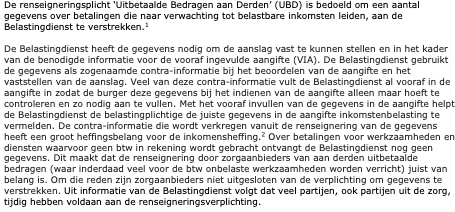
De minister en staatssecretaris leggen uit dat Belastingdienst de informatie gebruikt voor het vooraf invullen van de aangifte en als contra-informatie:


Andere vragen gaan over de administratieve lasten die de renseigneringsverplichting oplevert.


[*] Bijvoorbeeld bij digitale platformen.


Meer informatie:

Geplaatst in Belastingrecht, Financieel recht, onder meer Wft, Wtt, Fraude, witwasbestrijding, Wwft, ICT, privacy, e-commerce | Tags: , | 1 reactie

De banken hebben geen fysieke kantoren meer | antwoorden op kamervragen

Terwijl banken er steeds meer overheidstaken bij krijgen, verdwijnen de fysieke kantoren in hoge snelheid en wordt de kwaliteit van de dienstverlening steeds minder.

Onlangs gaf de minister van Financiën antwoord op vragen uit de Tweede Kamer over de transformatie van banken naar digitale dienstverleners, onder de titel ‘Bankkantoren met een loep zoeken: ABN heeft er nog maar 27’. Volgens de minister is er niets aan de hand en blijven banken fysieke dienstverlening verrichten en schrijft onder meer:

Naar aanleiding van het hiervoor genoemde DNB-rapport hebben de Nederlandse Vereniging van Banken en de Betaalvereniging Nederland namens de vier grootbanken een statement gepubliceerd [5] . Hierin spreken zij een versterkt commitment uit om de toegankelijkheid van het betalingsverkeer te verbeteren, garanderen zij dat niet-digitale klanten gebruik kunnen blijven maken van nietdigitale basisbankdiensten, zo lang als dat nodig is, en kondigen zij een aantal acties aan, zowel op de korte als lange termijn, om de toegankelijkheid te verbeteren.

[5] ‘Commitment van banken voor beter toegankelijk betalingsverkeer’, te raadplegen via: Commitment van banken voor beter toegankelijk betalingsverkeer (nvb.nl)

Communicatie is moeilijk voor banken

In de vragen en antwoorden ontbreekt dat communicatie per post met banken grote problemen oplevert (soms komt post niet aan, raakt weg of wordt geweigerd). Sommige banken bieden voor digitale communicatie over vertrouwelijke gegevens (zoals het Wwft-cliëntenonderzoek) alleen e-mail en beschikken niet over een beveiligd kanaal.

Op communicatief gebied behoren banken zelf tot de kwetsbare groepen (kwetsbare groepen van een andere soort zijn een belangrijk thema in de antwoorden).

Geplaatst in Bankrekening krijgen en behouden, Financieel recht, onder meer Wft, Wtt, Fraude, witwasbestrijding, Wwft, Grondrechten, ICT, privacy, e-commerce | Tags: , , , , , | Plaats een reactie

eHealth, eID wallet and other topics in the draft implementing decision for the Digital Decade Policy Programme 2030

Until 13 March a European consultation is running regarding the Digital Decade Policy Programme 2030, that the EDICs I wrote about today are part of.
The consultation is about a draft for a Commission implementing decision setting out key performance indicators (KPIs) to measure the progress towards the digital targets established by Article 4(1) of the relevant decision:

Article 4 Digital targets
1. The European Parliament, the Council, the Commission and the Member States shall cooperate with a view to achieving the following digital targets in the Union by 2030 (the ‘digital targets’):
(1) a digitally skilled population and highly skilled digital professionals, with the aim of achieving gender balance, where:

(a) at least 80 % of those aged 16-74 have at least basic digital skills;
(b) at least 20 million ICT specialists are employed within the Union, while promoting the access of women to this field and increasing the number of ICT graduates; (…)

In the draft implementing decision several contentious issues are mentioned.

E-health records, eID wallet
Article 2 (1) mentions KPIs in regard to national e-health records and eID wallets:

(15) Access to e-health records, measured as: (i) the existence of a nationwide mechanism, for citizen online access to health data, such as a patient portal, or a patient mobile app with additional measures in place that enable certain categories of people (e.g. guardians for children, people with disabilities, elderly) to also access their data, and (ii) the percentage of individuals that have the ability to obtain or make use of their own minimum set of healthrelated data currently stored in public and private electronic health-record (EHR) systems.

(16) Access to eID measured as the number of Member States that have issued a wallet in accordance with the Proposal for a Regulation of the European Parliament and of the Council amending Regulation (EU) No 910/2014 as regards establishing a framework for a European Digital Identity9 . In the first 2 years, it will also be monitored based on the number of Member States that have notified at least one national eID scheme in accordance with Regulation (EU) No 910/2014.

Quantum computing, big data and artificial intelligence
Other KPIs concern quantum computing, big data and artificial intelligence:

(7) Quantum computing measured as the number of unique Union quantum computing hardware systems/services, as well as reporting on European technical leadership and European impact leadership. European quantum computing hardware system/services are hardware stack systems/services demonstrating quantum advantage (i.e., outperforming a non-quantum hardware system/service in the solution of the same problem) using an ad-hoc benchmark created for proof. European technical leadership is measured as the use of a widely adopted quantum volume benchmark for the largest quantum computing capacity. European impact leadership is measured as number of quantum algorithms and use cases created with clear impact orientation in basic science, applied science, industries, and the public sector. (…)

(9) Big data, measured as the percentage of enterprises analysing big data from any data source (internal or external) [6]. As of the 2024 report, big data will be measured by the percentage of enterprises performing data analytics (internally or externally).

[6] As defined in the Commission Regulation (EU) 2019/1910 of 7 November 2019 implementing Regulation (EC) No 808/2004 of the European Parliament and of the Council concerning Community statistics on the information society for reference year 2020 (Text with EEA relevance), and subsequent implementing regulations pursuant to Regulation (EU) 2019/2152 of the European Parliament and of the Council (Text with EEA relevance), in particular Article 7(1) and Article 17(6) thereof.
(10) Artificial intelligence, measured as the percentage of enterprises using at least one artificial intelligence technology.

No KPIs on the protection of human beings against digital abuses
Unfortunately, KPIs on capacity of privacy authorities and their action against digital abuses are missing. One of the private persons already refers to this (source), passage blauw gemarkeerd:

Die Digitalziele, wie in Artikel 4 des Beschlusses (EU) 2022/2481 festgelegt, werden nur zu erreichen sein, wenn sie von der betroffenen Bevölkerung akzeptiert und unterstützt werden. Dies setzt einen wirksamen und nachvollziehbaren Schutz der Privatsphäre bei allen technischen und digitalen neuen Möglichkeiten voraus. Ohne inhärenten Datenschutz werden die Digitalziele nicht zu verwirklichen sein und wären auch nicht erstrebenswert. Daher sollten bei den KPIs auch entsprechende Messverfahren und Indikatoren für das Datenschutzniveau und dessen Durchsetzungsfähigkeit hinzugefügt werden.

Hopefully, there will be civil rights organisations that will point this out in their contribution to this consultation.


More information:

Digital Decade Policy Programme 2030: Decision (EU) 2022/2481 of the European Parliament and of the Council of 14 December 2022 establishing the Digital Decade Policy Programme 2030:

Consultation regarding a draft implementing decision “setting out key performance indicators to measure the progress towards the digital targets established by Article 4(1) of Decision (EU) 2022/2481“:

A lot of feedback is removed, stating: “This feedback was removed as it did not comply with the European Commission’s rules for publishing feedback and suggestions. Any feedback that users report to us as inappropriate will be examined and removed if necessary. Please take a look at the rules for feedback and suggestions to learn more about the guidelines for this site.“

Geplaatst in English - posts in English on this blog, Europa, Grondrechten, ICT, privacy, e-commerce | Tags: , , , , , , , , , , , , , | Plaats een reactie

New legal entities created by the European Commission | European digital infrastructure consortia (EDICs)

Those interested in the law of legal persons will be fascinated by the new legal entities created by the European Commission.

This phenomenon is to be found in Decision (EU) 2022/2481 of 14 December 2022 establishing the Digital Decade Policy Programme 2030. The new entity is called a ‘European digital infrastructure consortium‘ (EDIC).

The European Commission will create EDICs
Member States may implement a multi-country project by means of an EDIC. It is interesting to see that the European Commission will create these entities, Article 13 (3):

EDICs shall have legal personality from the date of entry into force of the relevant Commission decision

EDICs will have full legal capacity, Article 13 (4):

EDICs shall have in each Member State the most extensive legal capacity accorded to legal entities under the law of that Member State. They may, in particular, acquire, own and dispose of movable, immovable and intellectual property, conclude contracts and be a party to legal proceedings.

Article 14 describes the setting up of an EDIC, including a public register held by the Commission:

Article 14 Setting up an EDIC

1. Member States applying to set up an EDIC shall submit a written application to the Commission. The application shall contain the following:

(a) a request to the Commission to set up the EDIC;
(b) the proposed Statutes of the EDIC;
(c) a technical description of the multi-country project to be implemented by the EDIC;
(d) a declaration by the host Member State whether it recognises the EDIC as an international body as referred to in Article 143(1), point (g), and Article 151(1), point (b), of Directive 2006/112/EC and as an international organisation as referred to in Article 12(1), point (b), of Directive 2008/118/EC, from the date on which the EDIC is set up.

The limits and conditions of the exemptions provided for in the provisions referred to in point (d) of the first subparagraph shall be laid down in an agreement between the members of the EDIC.

2. The Commission shall assess the application on the basis of the conditions set out in paragraph 1 of this Article. It shall take into account the general objectives, as well as the purposes and goals of the multi-country project, pursuant to Article 10(1) and (2), and practical considerations related to the implementation of the multi-country project to be implemented by the EDIC.

3. The Commission shall, taking into account the results of the assessment referred to in paragraph 2 of this Article, adopt by means of implementing acts either of the following:

(a) a decision setting up the EDIC, after it has concluded that the requirements laid down in Articles 13 to 21 are met; or
(b) a decision rejecting the application, if it concludes that the requirements laid down in Articles 13 to 21 are not met, including in the absence of the declaration referred to in paragraph 1, point (d), of this Article.

In the event of a decision rejecting the application under point (b) of the first subparagraph of this paragraph, Member States may form a consortium by way of an agreement. Such a consortium shall not be considered to be an EDIC and shall not benefit from the implementation structure laid down in Articles 13 to 21.

Those implementing acts shall be adopted in accordance with the examination procedure referred to in Article 23(2).

4. Decisions referred to in paragraph 3, point (a) or (b), shall be notified to the applicant Member State. Where the application is rejected, the decision shall be explained in clear and precise terms.

5. The Commission shall annex the essential elements of the Statutes of the EDIC referred to in Article 17(1), points (c), (d), (e) and (i), to the decision setting up an EDIC.
Decisions setting up an EDIC shall be published in the Official Journal of the European Union. The Commission shall establish a publicly accessible list of the EDICs set up, and shall update the list in a timely and regular manner.

Other topics:

  • Article 15 – the membership of an EDIC.
  • Article 16 – the governance of an EDIC.
  • Article 17 – the statutes of an EDIC.
  • Article 18 – liability of an EDIC,.
  • Article 19 – applicable law and jurisdiction.
  • Article 20 – winding-up of an EDIC.
  • Article 21 – reporting by and control of an EDIC.

The only thing that is missing is that the Decision does not inform the public who the beneficial owners of the EDIC are and in which member state the beneficial owners will be registered.


More information:

  • Decision (EU) 2022/2481 of the European Parliament and of the Council of 14 December 2022 establishing the Digital Decade Policy Programme 2030: page; English version: html, pdf; NL: html, pdf.


Geplaatst in English - posts in English on this blog, Europa, Rechtspersonenrecht | Tags: , , , | 1 reactie

Privacyonderzoek naar socialmedia-monitoring door overheidsinstanties | AVG

Op security.nl las ik het bericht Privacyonderzoek naar socialmedia-monitoring door overheidsinstanties.

Toch wel zielig dat de overheid niet mag wat adtech [*], criminelen en trollen naar hartenlust doen en waar ze mee weg komen omdat er onvoldoende handhaving is.


[*] Advertentiebedrijven zoals Google, Meta/Facebook c.s.

Geplaatst in ICT, privacy, e-commerce | Tags: , , , , , | Plaats een reactie

Verslag van een overleg over WGS is ook relevant voor het bancaire sleepnet | plan van aanpak witwassen, Wwft

Het ministerie van Financiën denkt op dit moment na over de beantwoording van de vele vragen die zijn gesteld over het wetsvoorstel plan van aanpak witwassen.

Aanverwante thematiek is aan de orde bij het voorstel voor de Wet gegevensverwerking door samenwerkingsverbanden (WGS), dat nu bij de Eerste Kamer ligt. Lees het verslag [*], waarin uitgebreid wordt ingegaan op onder meer:

  • de vraag wanneer gegevens van burgers mogen worden verwerkt (verdenking of ander startpunt),
  • wanneer massasurveillance mag plaats vinden,
  • wanneer degenen die onderzocht worden worden geïnformeerd (ook als ze ten onrechte onderzocht zijn), zoals in de AVG voorgeschreven,
  • welk waarborgen er tegen discriminatie zijn bij het toepassen van risicoprofilering,
  • aanscherping regels inzake artificial intelligence,
  • hoe het zit met de waarborgen tegen onjuist gebruik, zoals doelbinding, dataminimalisatie,
  • hoe de risico-indicatoren bij de geautomatiseerde gegevens analyse worden getoetst,
  • hoe er zicht wordt gehouden op gebruikte IT-systemen,
  • of de capaciteit van de Autoriteit Persoonsgegevens voldoende is om tijdig te kunnen ingrijpen.

Dit zijn onderwerpen die ook voor het bancair sleepnet relevant zijn.


[*] Verslag van een schriftelijk overleg over de reactie op nadere adviezen over het wetsvoorstel Wet gegevensverwerking door samenwerkingsverbanden (WGS) (Kamerstuk 35447-21): pagina site Tweede Kamer, verslag.


Op dit blog staan berichten over de en over onder meer: , de in plan van aanpak witwassen, het en het in het algemeen.

Geplaatst in Bankrekening krijgen en behouden, Financieel recht, onder meer Wft, Wtt, Fraude, witwasbestrijding, Wwft, Grondrechten, ICT, privacy, e-commerce | Tags: , , , , , , , , , , , , , | Plaats een reactie