AML Package in the Working Party on Financial Services and the Banking Union (Financial Services) (Council), 18 July

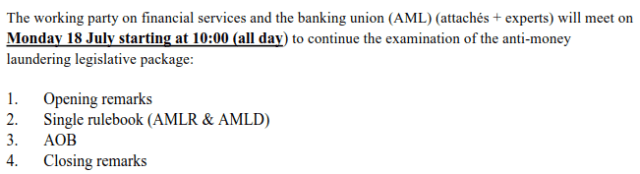
On Monday 18 July next, the Working Party on Financial Services and the Banking Union (Financial Services) of the European Council will be meeting all day about the AML package (meeting information, notice of meeting and provisional agenda).

Out of the limelight, the AML package is being negotiated in Europe.

As I wrote before (in Dutch), the Dutch Parliament is not sufficiently aware of the drastic changes that are coming. Possibly it is the same for other national parliaments and other stakeholders.

The provisional agenda:


My general page on the AML package is to be found here. Articles are found with the AML Package tag.

Geplaatst in English - posts in English on this blog, Europa, Financieel recht, onder meer Wft, Wtt, Fraude, witwasbestrijding, Wwft | Tags: , , , , | Plaats een reactie

European Parliament: PETI Fact Finding Mission FATCA [2]

Around an hour ago the PETI committee published the following press release on its FATCA-visit:

FATCA: MEPs discuss tax information exchange laws in Washington, D.C.
Press Releases PETI 1 hour ago

A delegation of MEPs from the Petitions Committee will travel to Washington, D.C. on 18 July to discuss the Foreign Account Tax Compliance Act (FATCA) and its impacts in the EU.
During their four-day visit to the United States capital, the MEP delegation from the Petitions Committee will discuss tax policy and raise awareness of the current situation with key stakeholders. They will meet with the EU Ambassador to the U.S. Stavros Lambrinidis; U.S. Representatives sponsoring the bill “Overseas Americans Financial Access Act“, currently being examined by Congress; officials at the U.S. Department of Treasury and Internal Revenue Service; and academics, NGOs and other stakeholders in the field of tax policy.

MEPs participating in the mission:
Yana TOOM (Renew, ET) – Head of Delegation
Cristina MAESTRE MARTÍN DE ALMAGRO (S&D, ES)
Ulrike MÜLLER (Renew, DE)
Alexander BERNHUBER (EPP, AT)
Marc ANGEL (S&D, LU)
Kosma ZŁOTOWSKI (ECR, PL)
Mario FURORE (NI, IT)

Background
Several petitions have highlighted issues with the consequences of the Foreign Account Tax Compliance Act (FATCA), the US law on international tax information exchanges. Previously, the Petitions Committee organised a public hearing on the topic and commissioned academic research on the impact of the law.

Geplaatst in Bankrekening krijgen en behouden, Belastingrecht, English - posts in English on this blog, Europa, Financieel recht, onder meer Wft, Wtt, Fraude, witwasbestrijding, Wwft, Grondrechten | Tags: , , , , | Plaats een reactie

States as platforms under new EU (online platforms’) law | Papakonstantinou on European Law Blog

Vagelis Papakonstantinou for European Law Blog wrote the article States as platforms under new EU (online platforms’) law in which he discusses the consequences of the Digital Services Act (DSA) and the Digital Markets Act (DMA) for states.

Geplaatst in English - posts in English on this blog, Europa, ICT, privacy, e-commerce | Tags: , | Plaats een reactie

European Parliament: PETI sends Fact Finding Mission to Washington D.C. regarding FATCA

The Committee on Petitions (PETI) of the European Parliament is sending a delegation to the US to discuss the harm done by FATCA. Read PETI’s announcement:

18-07-2022 09:00

Fact Finding Mission to Washington D.C.

A delegation of the PETI Committee will go to Washington DC from 18 to 22 July, to raise awareness and discuss the impact of the US Foreign Account Tax Compliance Act (FATCA) on EU citizens and to have exchanges of views with tax officials, Senators and Representatives in Congress and stakeholders, to find concrete solutions for the problems of the numerous EU citizens and their family members impacted by the extraterritorial application of citizenship-based taxation.

The PETI delegation is a follow-up of recently discussed petitions relating to the effects of FATCA on EU citizens, especially those with dual EU-US nationality, including difficulties for US residents in the European Union to access some financial services and alleged infringements of EU rights and exemptions from some consumer protection legislation.

Members participating in the mission:
Yana TOOM (Renew) – Chair of Delegation
Cristina MAESTRE (S&D)
Ulrike MÜLLER (Renew)
Alexander BERNHUBER (EPP)
Marc ANGEL (S&D)
Kosma ZŁOTOWSKI (ECR)
Mario FURORE (NI)

Media:


More information:

Other posts on this blog regarding PETI on FATCA:

General information on this blog on FATCA and Citizenship Based Taxation:

Geplaatst in Bankrekening krijgen en behouden, Belastingrecht, English - posts in English on this blog, Europa, Financieel recht, onder meer Wft, Wtt, Fraude, witwasbestrijding, Wwft, Grondrechten | Tags: , , , , | Plaats een reactie

Indiening wetsvoorstel Tijdelijke wet transparantie turboliquidatie | boek 2 BW

Het wetsvoorstel Tijdelijke wet transparantie turboliquidatie is bij de Tweede Kamer ingediend. Het voorstel schrijft extra formaliteiten voor als turboliquidatie plaats vindt en het lijkt er op dat die extra formaliteiten ook gelden als er geen schulden zijn bij het eindigen van de rechtspersoon.

Kern van het voorstel is dit nieuwe artikel in boek 2 van het Burgerlijk Wetboek:

Artikel 19b
1. Als de rechtspersoon is ontbonden overeenkomstig artikel 19 lid 1 onderdeel a en gelijktijdig heeft opgehouden te bestaan als bedoeld in artikel 19 lid 4, deponeert het bestuur binnen veertien dagen na de ontbinding bij de registers waar de rechtspersoon is ingeschreven:
a. een balans en een staat van baten en lasten met betrekking tot het boekjaar waarin de rechtspersoon is ontbonden en het voorgaande boekjaar als er op het moment van ontbinding over dat jaar nog geen jaarrekening openbaar is gemaakt;
b. een beschrijving van:

1º. de oorzaak van het ontbreken van baten op het tijdstip van de ontbinding;
2º. indien aan de orde, de wijze waarop de baten van de rechtspersoon te gelde zijn gemaakt en de opbrengsten zijn verdeeld, en
3º. indien aan de orde, de redenen waarom een schuldeiser of schuldeisers geheel of gedeeltelijk onbetaald zijn gebleven, en
c. de jaarrekeningen inzake de boekjaren die vooraf zijn gegaan aan het boekjaar waarin de rechtspersoon is ontbonden, indien daarvoor op grond van artikel 394 lid 3 van dit boek een plicht tot openbaarmaking bestaat waar nog niet aan is voldaan, in voorkomend geval inclusief de accountantsverklaring, bedoeld in artikel 393 lid 5.

2. Onverwijld nadat deze deponeringen zijn gedaan, doet het bestuur daarvan schriftelijk mededeling aan de schuldeisers.

Voorts wordt een nieuw artikel 19c voorgesteld die de mogelijkheid biedt een bestuursverbod op te leggen als niet aan de vereisten van artikel 19b is voldaan.


Meer informatie:

Geplaatst in Fraude, witwasbestrijding, Wwft, Rechtspersonenrecht | Tags: | Plaats een reactie

Unhealthy IT | European Parliament and Mental Health in the Digital World of Work

It is becoming more and more clear that digitalisation is very unhealthy for people. This includes dangers for employees and other workers, for instance caused by workplace surveillance.

The European Parliament recently has discussed mental health in the digital world of work. The Committee on Employment and Social Affairs of the Parliament has published an interesting report that still is too optimistic of the possibilities of digitalisation, but that also notes the dangers (markup by me):

13. Recalls that proactive approaches to digitalisation, such as improving digital skills in the workplace or allowing for flexible working hours, can help to mitigate work-related stress; points out that AI has the potential to improve working conditions and quality of life, including a better work-life balance and better accessibility for persons with disabilities, to predict labour market development and to support human resources management in preventing human bias; cautions, however, that AI also gives rise to concerns over privacy and occupational health and safety such as the right to disconnect, and can lead to the disproportionate and illegal surveillance and monitoring of workers, infringing on their dignity and privacy, as well as discriminatory treatment in recruitment processes and other areas due to biased algorithms, including on the grounds of gender, race and ethnicity; is concerned, furthermore, that AI can undermine the freedom and autonomy of people, such as through prediction and flagging tools, real-time monitoring and tracking and automated behavioural nudges, and contribute to workers’ mental health problems such as burnout, technology-related stress, psychological overload and fatigue; stresses that AI solutions in the workplace must be transparent, fair and avoid any negative implications for workers and must be negotiated between employers and workers’ representatives including trade unions; calls on the Commission and the Member States, in this regard, to devise a legislative proposal on AI in the workplace to ensure appropriate protection for workers’ rights and well-being, including their mental health and fundamental rights such as non-discrimination, privacy and human dignity in an increasingly digitalised workplace; notes that online harassment tends to have a disproportionate impact on the most vulnerable groups including younger, female and LGBTQI+ workers; stresses that only 60 % of Member States have specific legislation in place to address bullying and violence at work, and calls on the Commission and the Member States, therefore, to propose targeted mandatory measures to reverse and tackle this increasing problem at work and protect the victims with all the necessary resources; (…)

15. Stresses the need to protect workers from exploitation by their employers in the use of AI and algorithmic management, including prediction and flagging tools to predict employee behaviour and identify or deter rule-breaking or fraud by workers, real-time monitoring of progress and performance, time-tracking software and automated behavioural nudges; calls for a ban on the surveillance of workers;

On 5 July the European Parliament adopted a resolution, read the press release with amongst others:

Teleworking’s health and privacy risks

MEPs warn about the risks to workers’ mental health and the threats to the right to privacy posed by technology-enabled control and surveillance through software and AI tools, remote real-time monitoring of progress and performance and time-tracking. They also point to other factors causing additional stress, including financial insecurity, fear of unemployment, limited access to healthcare, isolation, as well as changes to working hours and inadequate work organisation because of the COVID-19 pandemic and subsequent economic crisis.

Additionally, they highlight the impact the shift to teleworking may have on the mental health of those at risk of digital exclusion. They say that the digital divide in the EU needs to be addressed to ensure that all workers have a sufficient level of digital skills.

Preventive measures and a directive to ensure the right to disconnect

MEPs urge the EU and member states to tackle the issue through an EU Mental Health Strategy, a European Care Strategy and national action plans. They note that the lack of binding common standards and principles regarding psychosocial risks in the EU leads to de facto unequal legal protection for workers. Parliament asks the EU institutions and member states to further regulate digital work to protect mental health, in cooperation with employers and workers’ representatives. The Commission, the European Agency for Safety and Health at Work and member states should include mental health in their health crisis and pandemic emergency response and preparedness plans.

MEPs call for a directive on minimum standards and conditions to ensure all workers the effective right to disconnect, and to regulate the use of existing and new digital tools for work purposes.

It is positive that the Parliament is aware of the risks of digitalisation for workers.

Still it remains worrying to see that Europe, in all kinds of legislation (e.g. anti-money laundering), shows that it does not understand the risks of digitisation for human dignity. For the time being I fear that we are heading for a digitally guided surveillance society.


More information:

Geplaatst in English - posts in English on this blog, Europa, Grondrechten, ICT, privacy, e-commerce | Tags: , , , , , | Plaats een reactie

Nieuwe regeling bestuursverslag in boek 2 BW | Implementatiewet Richtlijn openbaarmaking winstbelasting

Hoewel je het op basis van de titel van de wet niet zou zeggen, is het op 4 juli jl. bekend gemaakte voorstel ‘Implementatiewet Richtlijn openbaarmaking winstbelasting‘ een wijziging van boek 2 BW.

Er komt een kapstok in de titel over het jaarrekeningenrecht waaraan de openbaarmaking winstbelasting voor multinationals kan worden opgehangen, maar ook toekomstige duurzaamheidsverslagverplichtingen. De kern van het voorstel wordt gevormd door:

Na artikel 391 wordt in afdeling 7 een artikel ingevoegd, luidende:

Artikel 391a
1. Bij algemene maatregel van bestuur kunnen nadere voorschriften worden gesteld omtrent de inhoud van het bestuursverslag.
2. Bij of krachtens algemene maatregel van bestuur kunnen ter uitvoering van bindende EU-rechtshandelingen regels worden gesteld omtrent de verplichtingen van bepaalde rechtspersonen en bijkantoren tot het opnemen van informatie in het bestuursverslag, tot het opstellen en openbaar maken van een afzonderlijk jaarlijks verslag en tot het opstellen en openbaar maken van een of meer daarmee samenhangende verklaringen. De regels kunnen met name betrekking hebben op:
a. de inhoud van de informatie, het afzonderlijke jaarlijkse verslag en de verklaringen; b. de verantwoordelijkheid van het bestuur en de raad van commissarissen voor de naleving van de verplichtingen;
c. het laten onderzoeken van de informatie, het afzonderlijke jaarlijkse verslag en de verklaringen door een accountant of accountantsorganisatie als bedoeld in artikel 393 of door een andere derde persoon of organisatie en op de openbaarmaking van de uitkomsten van dat onderzoek;
d. de wijze van handhaving van de verplichtingen;
e. de naleving van een bij de algemene maatregel van bestuur aan te wijzen gedragscode en op de inhoud, de openbaarmaking en het accountantsonderzoek van een verklaring inzake corporate governance.
3. De voordracht voor een krachtens lid 1 of lid 2 vast te stellen algemene maatregel van bestuur wordt niet eerder gedaan dan vier weken nadat het ontwerp aan beide Kamers der Staten-Generaal is overgelegd.


Meer informatie:

Geplaatst in Belastingrecht, Financieel recht, onder meer Wft, Wtt, Jaarverslaggeving, Rechtspersonenrecht | Plaats een reactie

EDPB’s opinion on Europe’s digital euro and AML/CFT | GDPR

Currently Europe is working on the introduction of a digital euro. In June the European Data Protection Board (EDPB) published its response to the European Commission’s targeted consultation on this digital euro. The response also covers the aspects of combating money laundering and terrorist financing (AML/CFT).

EDPB is of the opinion (page 20) that the use of cash shall be safeguarded throughout the EU as a privacy-preserving means of payment. This is as well the reason why the features of a digital euro shall be as close as possible to physical cash.

In regard of AML/CFT compliance cost EDPB comments (pages 21, 22) that the cost will depend on the detailed AML/CFT properties of each of the proposed design options, and:

With regard to transaction monitoring, for example, the EDPB’s proposal is the complete absence of checks (and not only simplified checks) under a certain threshold of low value transactions, as it is the case for the cash today, while higher value transactions would remain subject to standard controls. 

Regarding the risk profile of the digital euro as payment system they say:

The EDPB is of the view that the right balance between data protection and privacy, on one side, and AML/CFT policy objectives, on the other, shall be met. In order to reach this objective, the EDPB proposes the following principle: the introduction of a digital euro shall not alter the AML/CFT risk profile of the current payment system using cash as a widespread means of payment.

Thus, the design of the digital euro shall be crafted in such a way not to make it riskier, nor less risky, than the use of physical cash from an AML/CFT point of view. If riskier, the AML/CFT policy objective would be damaged. If less risky, it would be at the cost of the privacy policy objective. The design of the digital euro would thus benefit to be based on a proper AML/CFT risk assessment study before its introduction.

EDPB is of the opinion that in a right design of the digital euro (pseudonymisation) low-value transactions can be considered as low-risk transactions. If necessary de-pseudonymisation is possible (page 22).

Advanced privacy enhancing techniques are advised. EDPB also comments on the position of intermediaries and the right of the central bank to access personal data. A question on the same right for the new Authority for Countering Money Laundering and Financing of Terrorism (AMLA) was not in the questionnaire.


More information:


Read the articles on this blog on the digital euro.

Geplaatst in English - posts in English on this blog, Europa, Financieel recht, onder meer Wft, Wtt, Fraude, witwasbestrijding, Wwft, Grondrechten, ICT, privacy, e-commerce | Tags: , , , , , | Plaats een reactie

Whistle-blowing without privacy: the Italian SA fines hospital and IT service provider

Whistle-blowing is considered to be important to combat crime. However: GDPR is also playing a role in whistle-blowing cases as is seen in the decision of 7 April 2022 of the Italian data protection authority, published on 10 June on the EDPB website. Key findings:

The whistle-blowing management system in question tracked the accesses to the software as the connections to the whistle-blowing app were recorded and stored in firewall logs; accordingly, users of the app could be tracked including potential whistleblowers.  No information had been provided to employees on the processing of personal data for the purpose of reporting misconduct. Additional findings: no DPIA had been carried out; no entry for this processing activity was found in the record referred to in Article 30 GDPR; the authentication credentials enabling the ‘Corruption and Transparency Manager’ to access the whistle-blowing app had been handled inappropriately during the transition to the next incumbent.

Specific infringements were also found regarding the IT company that provided the whistle-blowing app to the hospital as a processor. The company in question failed to regulate its relations with the hosting provider both when acting as a processor (to the hospital) and when acting as a separate controller (in respect of its internal services, e.g. regarding management of its employees or accounting and administration activities).

Both the controller (the hospital) and the IT-provider were fined. From the summary of the decision:

The controller (the Public Hospital) failed to lay down adequate technical and organisational measures to ensure the appropriate level of security by having regard to the specific risks arising from the processing in question, which required implementing a whistle-blowing management system that was in line with the data protection by design and by default principles – also in the light of the opinion given in this respect by the Hospital’s Data Protection Officer (DPO).

The whistle-blowing service provider had not regulated its relationships with the hosting provider it relied upon both in connection with the multifarious processing activities for which it was the controller (in breach of Article 28, paragraphs 1 and 3, GDPR) – ranging from the management of its employees to accounting and administrative activities up to the processing inherent in supplying its services – and in respect of the processing activities for which it was a processor acting on behalf of its customers including the Perugia Public Hospital (in breach of Article 28, paragraphs 2 and 4, GDPR).

Both the Public Hospital and the IT company were fined EUR 40,000.


Geplaatst in English - posts in English on this blog, Europa, Fraude, witwasbestrijding, Wwft, Grondrechten, ICT, privacy, e-commerce | Tags: , , , , | Plaats een reactie

Update klokkenluiders artikel

Het artikel dat ik in februari jl. schreef over het klokkenluiderswetsvoorstel en de witwasbestrijding, heb ik geüpdate. De aangepaste versie kan hier worden geraadpleegd.

Geplaatst in Europa, Financieel recht, onder meer Wft, Wtt, Fraude, witwasbestrijding, Wwft | Tags: , | Plaats een reactie