‘Antifa’, de opvolger van ‘woke’ als je mensen met andere opvattingen weg wil zetten | leden Tweede Kamer diskwalificeren zichzelf

Er zijn allerlei mooie taalkundige manieren om iedereen met ‘foute’ opvattingen weg te zetten. Daarbij wordt alles op één hoop gegooid: gegronde kritiek en warhoofdverhalen.
Vroeger heette dat bijvoorbeeld ‘het establishment’ (die zijn fout). Het is nog steeds in de mode over ‘de elite’ te spreken (eveneens heel fout), al lijkt het soms dat dit al iedereen is die de middelbare school heeft afgemaakt. Uit de Verenigde Staten is ‘woke’ afkomstig. Ik heb nooit begrepen wat het inhoudt, tot ik snapte dat het simpel betekent dat je het met de ander niet eens bent. Misschien dat taalliefhebbers een keer een overzicht kunnen maken van alle uitdrukkingen waarmee de vloer met andere opvattingen wordt aangeveegd.

Nu is ‘antifa’ uit de VS overgewaaid. Een deel van de Tweede Kamer is modegevoelig en gaat daar zonder na te denken in mee, zo blijkt uit de motie die onlangs met steun van de VVD is aangenomen. Die motie luidt:

constaterende dat de Verenigde Staten zojuist hebben besloten om antifa als terroristische organisatie aan te merken; overwegende dat ook in ons land antifacellen actief zijn die politici bedreigen, bijeenkomsten verstoren, studenten en journalisten intimideren en er niet voor terugdeinzen om geweld te gebruiken; verzoekt de regering om antifa ook in Nederland als terroristische organisatie aan te merken,

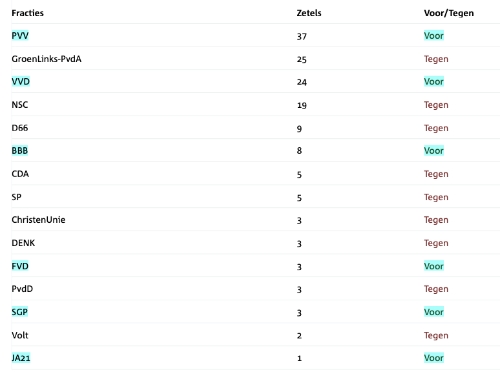
Dat ‘antifa’ helemaal niet bestaat, speelt geen rol voor de leden van de Tweede Kamer die voor deze motie hebben gestemd, dat zijn (blauw gemarkeerd):

Deze partijen hebben zich gediskwalificeerd door voor deze motie te stemmen met hun onderbuik in plaats van hun hersens te gebruiken.
Ze hebben daarmee aangegeven dat er tijdens de komende verkiezingen door de burgers van Nederland beter niet op hen kan worden gestemd, want de belangen van ons land zijn bij hen niet in goede handen.


PS Uitleggen dat antifa niet bestaat heeft natuurlijk geen zin, maar volledigheidshalve meld ik toch maar even dat Beatrice de Graaf, deskundig op het gebied van terrorismebestrijding, een lezersbrief aan het NRC heeft gestuurd, die hier te vinden is, waarin ze schrijft: “De motie om Antifa op de terrorismelijst te laten zetten (19/9) is onpraktisch, onuitvoerbaar en antidemocratisch. (…) Hier vraagt de Kamer nu aan de minister om op politieke gronden een aanwijzingsbesluit te geven, en dus zelf te gaan bepalen wat terrorisme is. (…) Verder is de motie ook niet goed uitvoerbaar. Want ten eerste is Antifa niet één gekende organisatie, ten tweede zijn sommige antifa-groepen en -leden misschien wel degelijk gewelddadig of zelfs extremistisch, maar dat is nog geen terrorisme. (…) Dan is er dus een andere bedoeling in het spel, dat brengt me bij het antidemocratische karakter van de motie. Want rechtse populisten kunnen nu de ongrijpbaarheid van de categorie Antifa gebruiken om vermeende politieke tegenstanders monddood te maken . Terrorisme is immers één van de meest gevaarlijke begrippen in handen van de overheid, want het geeft de mogelijkheid om vergaande maatregelen te nemen. Je kunt op grond van logo’s, vlaggen, contacten mensen als terrorist arresteren, vastzetten en veroordelen, voordat ze geweld hebben gepleegd. Het begrip terrorisme moet je dus heel precies en terughoudend toepassen.“.
Lees ook het commentaar van een oud-AIVD’er in een artikel over deze onverstandige motie.

Geplaatst in Fraude, witwasbestrijding, Wwft, Grondrechten | Tags: , , , | 1 reactie

The latest on FATCA and Citizenship-Based Taxation

This article contains some recent information about FATCA / Citizenship-Based Taxation and about attempts to persuade national governments and the EU to give substance to the fundamental rights to which European citizens are entitled.

Article: ‘Reconsidering Citizenship Taxation’, by Tsilly Dagan and Ruth Mason
Dagan and Mason wrote on the concept of citizenship taxation that is appealing to some states, read the abstract [1]. John Richardson published an AI generated podcast on the article.

Questions to the European Commission, answered on 22 July 2025
On 14 May 2025 the member of the European Parliament François-Xavier Bellamy asked the Commission a question on ‘Non-evaluation of FATCA agreements by Member States and protection of fundamental rights of EU citizens‘ [2]. Commissionar Mr McGrath answered on 22 July 2025 [3] on behalf of the European Commission.

Disappointing decision by the Gelderland court, 23 July 2025
The Rechtbank Gelderland on 23 July 2025 decided in a Dutch FATCA-case that the Dutch tax authority does not have to stop providing personal data on accidental Americans. There is a press release on the decision.

AAA-letter to EDPB of 20 September 2025
The president of the French association of Accidental Americans, l’Association des Américains Accidentels (AAA), Mr. Lehagre informed the public that on 20 September 2025 AAA has sent a letter to the European Data Protection Board (EDPB) to raise concerns about the risks linked to tax data transfers to the United States under FATCA [4].

Decision Polish Data Protection Authority of 23 July 2025
In another message [5] Lehagre refers to a recent decision of the Polish Data Protection Authority (UODO) in case DKN.5112.6.2020 that European data protection law (GDPR) also applies when applying AML/CFT rules [6].

Hearing in Belgian FATCA-case on 22 October 2025
Lehagre also mentions [4] that in the Belgian FATCA-case the Brussels Court of Markets on 22 October will hear the Belgian government’s appeal against the decision of the Belgian Data Protection Authority prohibiting FATCA-transfers.

Accidental Americans ask EDPB to intervene
Filippo Noseda, a lawyer who represents accidental Americans with the European Parliament (PETI committee), wrote a letter to EDPB on 23 September 2025 [7].


Notes

[1] Published on SSRN, abstract:
The pressures of globalization undermine the ability of states to collect taxes and pursue distributive justice. Free movement and other opportunities for people to engage with different jurisdictions on a personal and economic level are essential for liberty. But unrestrained market competition between states to provide the world’s wealthiest and most skilled a fragment of the social contract in exchange for a reduction in their tax obligations imperils the welfare state.
If the duty to pay taxes for redistribution exists within self-defining communities, then our new world of multiple and partial community allegiances raises fundamental questions. People are increasingly mobile, frequently live outside their state of nationality, and interact with multiple jurisdictions in a variety of ways. Although what constitutes membership may be decided by each such community independently, human mobility and interstate competition erode the ability of a single community, acting alone, to enforce its view of membership. As the community loses the ability to define itself and to bind people it considers members to that choice, the community also loses the material support it needs to sustain itself. In such a world, the very definition of community becomes subject to the rules of supply and demand, under which diverging elasticities and the relative attractiveness of both jurisdictions and taxpayers become paramount.
The strongest states may be able to overcome these challenges unilaterally with the aid of citizenship taxation. We emphasize, however, that the United States may remain an outlier in assessing citizenship taxation. US citizenship has proved extremely sticky, and therefore capable of sustaining a lightly administered form of citizenship taxation characterized by toleration for what is presumed to be widespread noncompliance. But weaker and less attractive states may be unable to sustain even a limited form of citizenship taxation, and they may therefore lose their tax base as they lose residents.
A cooperative accord on the global level could tame some interstate competition over migrants. Such a global accord would, however, face difficulties, including setting the desirable balance between personal liberty and community responsibility; determining the duty of justice between states; and defining the procedures that will determine the arrangements. States would also face accountability, legitimacy, and practical difficulties in implementing any such arrangements. These difficulties should not be underestimated, yet overcoming them is one of the challenges of the next 100 years of taxing people.”

[2] The question:
On 13 April 2021, the European Data Protection Board (EDPB) invited Member States to re-evaluate their international agreements involving transfers of personal data, in particular agreements struck with the United States under the Foreign Account Tax Compliance Act (FATCA), in order to make these agreements compliant with the General Data Protection Regulation (GDPR). Four years later, and not a single Member State has published the required evaluation. This inaction constitutes a blatant violation of the obligation of responsibility laid down in Article 24 of the GDPR. During this time, the data of thousands of EU citizens continues to be passed on to the Internal Revenue Service (IRS), the US tax authority, without demonstrated legal safeguards.
In France, the Finance Act for 2022 required the French Government to submit a report on the implementation of its information exchange commitments, in line with the GDPR and the recommendations of the EDPB. This report has never seen the light of day. The lack of political will to protect fundamental rights is clear.
At the same time, the IRS publicly asserts its right to collect data outside the United States, in total disregard of EU legislation.
1. Does the Commission consider it acceptable that this situation persists?
2. Does the Commission plan to launch infringement proceedings against the Member States that are failing to fulfil their obligations under EU law?
3. And, above all: is the Commission finally ready to guarantee that EU citizens’ data will be duly protected, even from non-EU powers?“.

[3] The answer:
The independent authorities competent to monitor and enforce compliance with the General Data Protection Regulation (GDPR) are the data protection authorities (DPAs) in the Member States, under the control of national courts.
Referring to Article 96 of the GDPR, the European Data Protection Board (EDPB), which brings together all EU DPAs, has invited Member States to assess their existing international agreements and, where necessary, review them with the aim of bringing them in line with EU law [1].
The DPAs have agreed to assist the Member States in this exercise and the Commission understands that several of them are in discussions with the relevant ministries [2].
Several DPAs have also been dealing with requests concerning the data protection aspects of these international agreements. For instance, the Belgian DPA recently issued a decision [3] on the Belgian agreement implementing the Foreign Account Tax Compliance Act (FATCA), concluding that the transfer of personal data of ‘accidental Americans’ to the Internal Revenue Service was unlawful.
The Belgian DPA ordered the relevant authority to bring the transfer of data in compliance within one year . Investigations in the same field are also ongoing in other Member States.
The Commission continues to closely follow further developments in this regard, including in collaboration with the EDPB. The Commission also continues to work with the authorities of the United States (US) including in the context of the bi-annual EU-US Regulatory Forum.
In parallel, the Commission is in close contact with the Member States, for example in the Council working group on tax questions, where Member States are exchanging views about the implementation of their international agreements in this area, including data protection safeguards.

[1] See EDPB Statement 04/2021 of 13 April 2021, available at https://www.edpb.europa.eu/system/files/2021-04/edpb_statement042021_international_agreements_including_transfers_en.pdf.
[2] See also the letter from the EDPB of 7 July 2021, available at https://www.edpb.europa.eu/system/files/2021-07/edpb_letter_out2021-0119_intveld_igas.pdf.
[3] Issued on 24 April 2025, see https://www.autoriteprotectiondonnees.be/publications/decision-quant-au-fond-n0-79-2025.pdf.

[4] The president of the Association des Américains Accidentels (AAA), Fabien Lehagre, wrote on linkedin:
✍ 𝐓𝐨𝐝𝐚𝐲, 𝐈 𝐬𝐞𝐧𝐭 𝐚 𝐥𝐞𝐭𝐭𝐞𝐫 𝐭𝐨 𝐭𝐡𝐞 𝐄𝐮𝐫𝐨𝐩𝐞𝐚𝐧 𝐃𝐚𝐭𝐚 𝐏𝐫𝐨𝐭𝐞𝐜𝐭𝐢𝐨𝐧 𝐁𝐨𝐚𝐫𝐝 (𝐄𝐃𝐏𝐁) 𝐭𝐨 𝐫𝐚𝐢𝐬𝐞 𝐜𝐨𝐧𝐜𝐞𝐫𝐧𝐬 𝐚𝐛𝐨𝐮𝐭 𝐭𝐡𝐞 𝐫𝐢𝐬𝐤𝐬 𝐥𝐢𝐧𝐤𝐞𝐝 𝐭𝐨 𝐭𝐚𝐱 𝐝𝐚𝐭𝐚 𝐭𝐫𝐚𝐧𝐬𝐟𝐞𝐫𝐬 𝐭𝐨 𝐭𝐡𝐞 𝐔𝐧𝐢𝐭𝐞𝐝 𝐒𝐭𝐚𝐭𝐞𝐬 𝐮𝐧𝐝𝐞𝐫 𝐅𝐀𝐓𝐂𝐀.
The repurposing of such data for non-tax purposes, without effective safeguards on the U.S. side, is a clear violation of the #GDPR.
This matter will soon be at the center of attention in Brussels, as the Market Court is set to hold a crucial hearing on October 22, following the landmark decision of the Belgian Data Protection Authority that #FATCA transfers violate the GDPR.
As national data protection authorities have reached divergent conclusions, it is urgent that clarification be provided at the European level. This is why we are calling on the European Data Protection Board to:
✅ take a position on how the GDPR applies to FATCA,
✅ encourage a preliminary reference to the CJEU,
✅ reaffirm that Article 49 derogations cannot legitimize systematic and recurring transfers.
🔒 𝐓𝐡𝐢𝐬 𝐟𝐢𝐠𝐡𝐭 𝐝𝐨𝐞𝐬 𝐧𝐨𝐭 𝐨𝐧𝐥𝐲 𝐜𝐨𝐧𝐜𝐞𝐫𝐧 𝐀𝐜𝐜𝐢𝐝𝐞𝐧𝐭𝐚𝐥 𝐀𝐦𝐞𝐫𝐢𝐜𝐚𝐧𝐬: 𝐢𝐭 𝐢𝐬 𝐚𝐛𝐨𝐮𝐭 𝐩𝐫𝐨𝐭𝐞𝐜𝐭𝐢𝐧𝐠 𝐭𝐡𝐞 𝐩𝐞𝐫𝐬𝐨𝐧𝐚𝐥 𝐝𝐚𝐭𝐚 𝐨𝐟 𝐚𝐥𝐥 𝐄𝐮𝐫𝐨𝐩𝐞𝐚𝐧 𝐜𝐢𝐭𝐢𝐳𝐞𝐧𝐬.“.

The letter can be uploaded here.

[5] The message:
🔎 𝐃𝐚𝐭𝐚 𝐩𝐫𝐨𝐭𝐞𝐜𝐭𝐢𝐨𝐧 𝐚𝐧𝐝 𝐅𝐀𝐓𝐂𝐀: 𝐚 𝐭𝐞𝐬𝐭 𝐟𝐨𝐫 𝐄𝐮𝐫𝐨𝐩𝐞
The recent decision of the Polish Data Protection Authority (UODO) in case DKN.5112.6.2020 reminds us that, even when complying with AML/CFT rules, banks cannot collect or process data in violation of the GDPR.
👉 𝐓𝐡𝐢𝐬 𝐩𝐫𝐢𝐧𝐜𝐢𝐩𝐥𝐞 𝐝𝐢𝐫𝐞𝐜𝐭𝐥𝐲 𝐫𝐞𝐬𝐨𝐧𝐚𝐭𝐞𝐬 𝐰𝐢𝐭𝐡 𝐭𝐡𝐞 𝐅𝐀𝐓𝐂𝐀 𝐜𝐚𝐬𝐞.
Here, not only is there a systematic collection of banking information, but this data is also transferred to a country – the United States – that does not provide equivalent data protection guarantees. Even worse, the #FATCA agreement governing these transfers lacks the safeguards normally required under the #GDPR.
📌 On 𝐎𝐜𝐭𝐨𝐛𝐞𝐫 𝟐𝟐, the Brussels Court of Markets will hear the Belgian government’s appeal against the decision of the Belgian Data Protection Authority prohibiting such transfers.
👉 𝐀 𝐝𝐚𝐭𝐞 𝐧𝐨𝐭 𝐭𝐨 𝐛𝐞 𝐦𝐢𝐬𝐬𝐞𝐝, 𝐚𝐬 𝐭𝐡𝐞 𝐢𝐦𝐩𝐥𝐢𝐜𝐚𝐭𝐢𝐨𝐧𝐬 𝐰𝐢𝐥𝐥 𝐛𝐞 𝐝𝐞𝐜𝐢𝐬𝐢𝐯𝐞 𝐟𝐨𝐫 𝐭𝐡𝐞 𝐟𝐮𝐭𝐮𝐫𝐞 𝐨𝐟 𝐝𝐚𝐭𝐚 𝐩𝐫𝐨𝐭𝐞𝐜𝐭𝐢𝐨𝐧 𝐢𝐧 𝐄𝐮𝐫𝐨𝐩𝐞.
🔗 𝐘𝐨𝐮 𝐜𝐚𝐧 𝐫𝐞𝐚𝐝 𝐭𝐡𝐞 𝐏𝐨𝐥𝐢𝐬𝐡 𝐃𝐏𝐀’𝐬 𝐝𝐞𝐜𝐢𝐬𝐢𝐨𝐧 𝐡𝐞𝐫𝐞 (𝐢𝐧 𝐄𝐧𝐠𝐥𝐢𝐬𝐡): https://gdprhub.eu/index.php?title=UODO_(Poland)_-_DKN.5112.6.2020“.

[6] From the summary on GDPR Hub on this case regarding ING Bank:
The DPA fined a bank PLN 18,416,400 (approximately €4,300,000) over the excessive and unlawful processing of customers’ identity documents. The DPA clarified that AML legislation does not allow for the indiscriminate scanning of customers’ IDs. (…)
AML law did not allow the controller to indiscriminately scan the ID documents of customers. Instead, the controller should have assessed each customer’s case individually before deciding whether the scanning of their ID was a necessary measure for AML compliance.
The DPA also considered that the scan of an ID document revealed more data than strictly necessary for customer identification. In the DPA’s view, it would have been sufficient to record the customer’s social security code (or, in the case of customers with no such code, to record other information on the documents, such as the document’s number and the customer’s personal details).
On these grounds, the DPA held that the controller violated Articles 5(1)(a)(b)(c) and 6(1) GDPR and fined the controller PLN 18,416,400 (approximately €4,300,000).
The DPA also clarified that while ID documents do not constitute sensitive data under the GDPR, their processing still involves a high risk.

[7] Upload the letter on this url.

Geplaatst in Belastingrecht, English - posts in English on this blog, Europa, Financieel recht, onder meer Wft, Wtt, Fraude, witwasbestrijding, Wwft, Grondrechten, ICT, privacy, e-commerce | Tags: , , , , , , , , | Plaats een reactie

Flawed assumptions about human oversight of Human Oversight of Automated Decision-Making | EDPS TechDispatch

The European Data Protection Supervisor (EDPS) today published a document on Human Oversight of Automated Decision-Making, available in html and pdf.

Flawed assumptions about human oversight of ADM

In the document the EDPS first discusses the incorrect assumptions about human oversight of automated decision-making (‘ADM’), in chapter 3, ‘Flawed assumptions about human oversight of ADM‘:

3.1 Wrong assumptions about the technology used in ADM systems
Assumption: ADM systems will operate within specific and predetermined conditions
Assumption: ADM systems will transfer control to humans when handling atypical or outlier situations

3.2 Wrong assumptions about how humans and technologies interact
Assumption: Automation does not influence human judgment
Assumption: There is no automated decision-making if there is a human supervising the system
Assumption: That human operators possess the authority to decide
Assumption: Systems combining human and machine work better
Assumption: Human operators have appropriate mechanisms to override the system’s decisions
Assumption: Transparency and explainable AI improve human oversight
Assumption: Human oversight can help address the system’s shortcomings

3.3 Wrong assumptions about how humans behave
Assumption: That human operators know what to do
Assumption: That human operators are able to do the task
Assumption: That human operators will have ‘fitting intentions’

Promoting more effective and meaningful human oversight

In chapter 4 the EDPS promotes more effective and meaningful human oversight through organisational measures (4.1), technical measures (4.2), the operator’s profile (4.3) and practical approaches (4.4) that include auditing, sampling, institutionalised distrust and integrating feedback from affected individuals.

Final remark

The document shows that careful application of AI in decision-making is expensive because of the safeguards needed to prevent harm. In AI marketing, this aspect is typically underestimated, and it is suggested that the use of AI inherently provides advantages.

Geplaatst in English - posts in English on this blog, Europa, Fraude, witwasbestrijding, Wwft, Grondrechten, ICT, privacy, e-commerce | Tags: , , , , , , , , | Plaats een reactie

Vereenvoudiging financiële regelgeving op de Ecofin-agenda – antiwitwaspakket en de digitale euro hebben geen kwantificeerbaar nut

Het ministerie van Financiën maakte onlangs stukken bekend inzake een informele Ecofinraad [*]. Onderwerp van de vergadering is vereenvoudiging van Europese financiële regelgeving.

Peperduur antiwitwaspakket heeft geen kwantificeerbaar nut
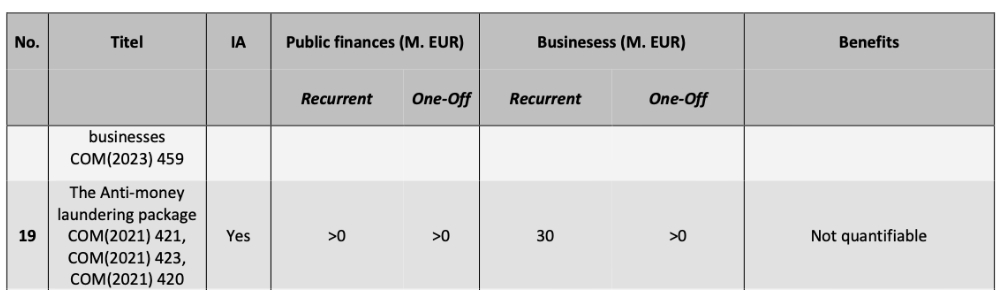
Opvallend is dat in één van de documenten, nl. Annex A: A first overview of economic costs from new regulation, wordt aangegeven dat het peperdure antiwitwaspakket (AML Package), dat er voor zal zorgen dat bedrijven zoals banken en boekhouders hoge kosten moeten maken om crimineel geld te detecteren (uiteraard wordt dat aan de klant doorberekend), een niet kwantificeerbaar nut heeft… (pagina 13)

Dure digitale euro
Dezelfde vermelding staat bij de digitale euro, eveneens peperduur omdat de banken de kosten moeten dragen en deze aan de klanten zullen doorberekenen (pagina 3):

Hoe Europa het financiële recht ingewikkeld en duur heeft gemaakt
Liefhebbers van het Europese recht kunnen in Appendix Session I New Financial een mooi verhaal vinden over hoe de EU regels belachelijk ingewikkeld zijn geworden, zie pagina’s 11-15.

Onderstaand pagina 11 als plaatje:


[*] Zie de pagina Nazending Presidency Issues Notes Informele Ecofinraad 19 en 20 september met een brief en een groot aantal stukken.

Geplaatst in Financieel recht, onder meer Wft, Wtt, Fraude, witwasbestrijding, Wwft, Grondrechten | Tags: , , , , , , , , | Plaats een reactie

“Waarom de invoering van de digitale identiteit dreigt vast te lopen”

Lees over de stand van zaken rondom de Europese Digitale Identiteit, ook wel EUDI-wallet of EDI-wallet genoemd, het iBestuur artikel Waarom de invoering van de digitale identiteit dreigt vast te lopen.

Geplaatst in Grondrechten, ICT, privacy, e-commerce | Tags: , , , , , | Plaats een reactie

The European CEO AI and critical tech declaration

Digital Europe, a network of companies, including Intel, EY and Philips [*], in a declaration urges the EU to reduce the regulatory burden.

Data
In the executive brief they write:

Europe’s data framework has grown increasingly complex, going beyond the well-established General Data Protection Regulation (GDPR) with overlapping rules like the Data Act and Data Governance Act (DGA) that impose significant burdens on businesses. These regulations often criminalise data markets before they fully develop, creating a burdensome environment around data sharing and governance. To avoid compounding these challenges, the application of the Data Act should be postponed to allow time for simplification under the upcoming digital package.

and have a lot of recommendations, also on GDPR:

Clarify the GDPR without reopening it:

  • Reinforce the use of ‘legitimate interest’ as a ground to process personal data for key use cases such as product development – including of AI models – and security.
  • Clarify that pseudonymised data is not personal data when recipients cannot reasonably re-identify individuals.

The proposal under the first bullet point does not seem to be in the interests of citizens.

AI
The AI Act is also being criticised:

However, its extensive scope and complexity pose significant challenges for industry compliance, particularly when it comes to harmonised standards, conformity assessments and the interaction with sector-specific legislation.

and they recommend amongst others to replace the fundamental rights impact assessments (FRIAs) with data protection impact assessments (DPIAs), which are already mandated by the GDPR.

Cybersecurity
According to the group the European cybersecurity framework has become highly fragmented, with overlapping reporting requirements from multiple regulations such as NIS2 and the Cyber Resilience Act (CRA), as well as sectoral frameworks like DORA for finance. On this topic there are many recommendations as well.

It is a powerful lobby group that makes far-reaching proposals. It is to be hoped that the interests of citizens and SMEs will be represented just as firmly.


[*] The organisation describes itself as “the leading trade association representing digitally transforming industries in Europe“.

Geplaatst in English - posts in English on this blog, Europa, Grondrechten, ICT, privacy, e-commerce | Tags: , , , , , , , , | Plaats een reactie

Rapport ondergronds bankieren en de rol van ‘de accountant’

Het WODC heeft het rapport Ondergronds bankieren in relatie tot georganiseerde criminaliteit in Nederland uitgebracht, geschreven door N. Liebregts, R. Meijer, M. Wesseling en C.A.J. van den Eeden [1]. Het onderzoek is gebaseerd op enige opsporingsdossiers en op interviews met ambtenaren die zich met opsporing bezig houden [2].

Het rapport maakt duidelijk dat dit geen domein is voor amateurs. De vraag of de amateurrechercheurs van de banken en andere witwasbestrijdingsplichtigen wel iets met het onderwerp kunnen, was geen onderwerp van het onderzoek [3].

Onjuist gebruik van de aanduiding ‘accountant’
Opvallend is dat men in het rapport het begrip ‘accountant’ gebruikt voor iemand die aan de tekst te zien boekhoudwerkzaamheden verricht en dus als ‘boekhouder’ of administrateur’ aangeduid had moeten worden. In het Nederlands behoort een accountant tot een door middel van de Wet op het accountantsberoep gereguleerde beroepsgroep. Het lijkt me onwaarschijnlijk dat mensen die de accountantstitel voeren de in het rapport beschreven activiteiten verrichten. Wellicht dat de onderzoekers zich op het gebied van de accountantsregels wat kunnen bijscholen zodat dit soort fouten in de toekomst kunnen worden voorkomen.


Noten:

[1] De begeleidingscommissie bestond uit C.G. van Wingerde, J. Ferwerda, M.R.J. Soudijn, J.J. Baars en J.J.E. van Pelt.
[2] Zie pagina 112: “Een laatste beperking in het verlengde van de voorgaande is de keuze om de interviews te houden met politie, justitie en relevante personen bij ministeries en overheidsinstanties.
[3] Er wordt op pagina 113 wel een opmerking over gemaakt: “Tot slot blijkt uit dit onderzoek dat ondergrondse bankiersnetwerken ook gebruikmaken van het reguliere financiële stelsel en bedrijfsstructuren. Daarom zou het goed zijn om het perspectief breder te trekken dan de opsporing door ook banken of andere financiële instellingen in vervolgonderzoek te betrekken.

Geplaatst in Dienstverlening - juridisch financieel [advocaten, accountants, belastingadviseurs e.d.], Financieel recht, onder meer Wft, Wtt, Fraude, witwasbestrijding, Wwft | Tags: , | Plaats een reactie

Kort geding rechter: agrariërs hebben geen recht op privacy als het om het milieu gaat | Woo

De kort geding rechter heeft onlangs besloten dat de minister van Landbouw, Visserij, Voedselzekerheid en Natuur agrarische gegevens (emissiegegevens), waarvan persoonsgegevens van agrariërs deel uit maken, op grond van de Wet open overheid (Woo) openbaar moet maken. De beslissing is in dit nieuwsbericht aangekondigd.

Journalisten hadden om die gegevens gevraagd.

De zaak ging onder meer over een verzoek van een journalist van Omroep Gelderland, die had gevraagd om (overweging 3.15):

openbaarmaking van een overzicht van alle agrarische ondernemingen in de provincie Gelderland waar rundvee, varkens, kippen, geiten en/of schapen gehouden worden, voor de jaren 2020, 2021, 2022, 2023. Opgevraagd is:
– van elk UBN het aantal geregistreerde dieren (rundvee, geiten en/of schapen) op de eerste dag van iedere maand. Dit hoeft alleen als het totaal aantal dieren 50 of meer is;
– de diercategorieën rundvee, varkens, kippen, geiten en/of schapen per UBN uitgesplitst volgens de RAV-codering en
– de postcode en het huisnummer die bij het UBN horen.

Uit de uitspraak blijkt dat het Adviescollege Openbaarheid & Informatiehuishouding (ACOI) advies heeft uitgebracht (overweging 3.1):

Op 19 mei 2025 heeft het ACOI het volgende advies uitgebracht:

“(…) De wetgever is namelijk heel duidelijk over het belang van openbaarheid van emissiegegevens: deze zijn zo belangrijk dat er geen enkele belangenafweging mogelijk is, het belang van openbaarheid prevaleert altijd.

Dit doet de wetgever met goede redenen. De uitstoot van schadelijke stoffen kan grote gevolgen hebben voor de leefomgeving en de gezondheid van mensen. Het is dan ook belangrijk dat zij kennis kunnen nemen van de details van die schadelijke stoffen, waar ze in de lucht, de grond, of ons water terechtkomen en welke stoffen dit precies zijn. Het is belangrijk dat mensen de overheid hierop kunnen controleren, en in actie kunnen komen als zij last hebben van de gevolgen. Het Adviescollege kan dan ook niet anders dan u te adviseren zo snel mogelijk een besluit te nemen, en de voorgenomen zienswijzeprocedure te stoppen. Deze is niet alleen duur en tijdrovend, de procedure is bovenal onnodig.”

De kort geding rechter overweegt (5.1):

Het recht op toegang tot publieke informatie is geregeld in de Woo. Artikel 1.1. van die wet bepaalt dat eenieder recht heeft op toegang tot publieke informatie zonder daartoe een belang te hoeven stellen, behoudens bij deze wet gestelde beperkingen. (…) Uit artikel 5.1 lid 7 volgt dat openbaarmaking van milieu-informatie die betrekking heeft op emissies in het milieu niet kan worden geweigerd. Volgens vaste rechtspraak zijn gegevens over aantallen op een agrarische omgeving gehouden dieren emissiegegevens. Dat geldt ook voor locatiegegevens, waaronder de bedrijfsadresgegevens.

In de zaak van de journalist van Omroep Gelderland heeft de minister geen uitvoering gegeven aan het onherroepelijke openbaarmakingsbesluit (overwegingen 5.12-5.14). De journalist heeft een spoedeisend belang dat zwaarder weegt dan dat van de minister (overwegingen 5.15-5.16).

Geplaatst in Grondrechten, ICT, privacy, e-commerce | Tags: , , , , , , | Plaats een reactie

Vragen uit de Eerste Kamer over de wijziging van de UAVG

Op 20 mei jl. nam de Tweede Kamer het wetsvoorstel tot wijziging van de UAVG aan. De Eerste Kamercommissie voor Digitalisering (DIGI) heeft op 1 juli 2025 een groot aantal vragen gesteld in het verslag (ook hier te vinden) naar aanleiding van het wetsvoorstel. Onder meer wordt gevraagd naar drie knelpunten die de UAVG:

volgens het Rathenau Instituut niet goed regelt, te weten: 1) de verwerking van genetische gegevens door commerciële analysebureaus en door werkgevers; 2) de verwerking van biometrische gegevens in de publiek ruimte; en 3) de verwerking van gezondheidsgegevens in het medische domein (WGBO) en daarbuiten (UAVG) en de verwerking van persoonsgegevens door hulpverleners in het kader van een «goede behandeling of verzorging c.q. beheer van de beroepspraktijk».

Er wordt gevraagd naar de reden voor een verwerkingsgrondslag van bijzondere persoonsgegevens door accountants:

De leden van de Volt-fractie wijzen erop dat de Raad van State heeft geadviseerd nader toe te lichten waarom het wetsvoorstel voorziet in een grondslag voor de verwerking van bijzondere persoonsgegevens door accountants in de UAVG. Deze leden vragen of de regering hierop kan reflecteren. Waarom is er bijvoorbeeld niet voor gekozen om deze specifieke bepaling uitsluitend in sectorale wetgeving vast te leggen?

Een fractie stelt vragen over de verwerking van persoonsgegevens door faillissementscuratoren en (Wsnp-)bewindvoerders:

De leden van de CDA-fractie vragen hoe de keuze voor deze algemene, weinig specifieke wettelijke grondslagen zich verhoudt tot het Europees Verdrag voor de Rechten van de Mens (EVRM), de Grondwet en de AVG.

Gegevensbescherming in het financiële recht
Ook de gegevensbescherming in het financiële recht komt aan bod. De kritiek van Privacy First dat de rechtsbescherming van klanten onvoldoende is, wordt genoemd:

De leden van de GL-PvdA-fractie hebben kennisgenomen van de voorgestelde wijziging van artikel 3:17 van de Wet op het financieel toezicht (Wft). In reactie op de voorgestelde wijziging stelt Privacy First dat «de rechtsbescherming van klanten in zaken op het gebied van de Wft en het financiële recht volstrekt onvoldoende is». 6 Dit geeft de leden van de GL-PvdA-fractie aanleiding tot het stellen van de volgende vragen. Deze leden vragen allereerst welke rechten een betrokkene heeft wanneer transacties worden geblokkeerd of opgeschort. Waar en op welke wijze zijn deze rechten verankerd? Voorts vragen zij wat de rol van het Klachteninstituut Financiële Dienstverlening (Kifid) is in dergelijke situaties voor consumenten. Kunnen ook zzp’ers en mkb’ers zich tot het Kifid wenden? Daarnaast vernemen deze leden graag of banken en betaalinstellingen wettelijk verplicht zijn om actief met betrokkenen te communiceren over de blokkering of opschorting van transacties. Zo ja, op welke wettelijke bepaling is die verplichting gebaseerd? Zo nee, acht de regering het wenselijk om dergelijke verplichting alsnog in te voeren?

6 Paper Privacy First inzake rondetafelgesprek Verzamelwet gegevensbescherming 4 december 2024, 1 december 2024, Externe link: https://privacyfirst.nl/wp-content/uploads/paper_UAVG_SPF_TK_1dec2024.pdf.

Ook de nieuwe bepalingen inzake transactiemonitoring in de Wft roepen vragen op:

De leden van de CDA-fractie hebben kennisgenomen van de twee voorgestelde leden die in artikel 3:17 van de Wet op het financieel toezicht (Wft) een verplichting tot het uitvoeren van een transactiemonitoring introduceren. Zij gaan ervan uit dat bij de uitvoering van transactiemonitoring gebruik wordt gemaakt van een zekere mate van artificiële intelligentie (AI). In dat verband wensen de leden enkele vragen te stellen. Deze leden vragen allereerst of door banken en betaalinstellingen randvoorwaarden worden verankerd die het mogelijk maken om achteraf te controleren hoe digitale uitvoering heeft plaatsgevonden en aan de hand van welke data algoritmen zijn getraind. Kan dit inzichtelijk worden gemaakt voor desbetreffende cliënten? Daarnaast vragen de leden van de CDA-fractie of banken en betaalinstellingen verplicht worden om jegens cliënten van wie transacties zijn geblokkeerd of opgeschort, inzichtelijk te maken op welke gronden dit besluit is genomen en op welke wijze algoritmen en AI hebben bijgedragen aan de totstandkoming ervan. Tot slot vragen deze leden welke mogelijkheden cliënten hebben om bezwaar te maken tegen het geautomatiseerd blokkeren of opschorten van een transactie.

Over het gebruik van digitale hulpmiddelen wordt ook het volgende opgemerkt:

De aan het woord zijnde leden merken op dat het wetsvoorstel niet voorziet in bijzondere bepalingen ten aanzien van de geautomatiseerde verwerking van persoonsgegevens. Naar het oordeel van deze leden kan daarvan wel sprake zijn, bijvoorbeeld bij het verwerken van biometrische gegevens, transactiemonitoring door banken of bankinstellingen en het delen van medische gegevens. Kan de regering toelichten of, en zo ja op welke wijze, zij voorziet dat er sprake zal zijn van de algoritmische uitvoering van dit wetsvoorstel of daaruit voortvloeiende regelgeving? En op welke wijze wordt gewaarborgd dat wordt voldaan aan de vereisten die de AVG stelt aan de geautomatiseerde verwerking van persoonsgegevens?

De leden van de GL-PvdA-fractie verzoeken de regering toe te lichten op welke wijze het toezicht op de uitvoering van dit wetsvoorstel wordt georganiseerd. Zij gaan ervan uit dat de Autoriteit Persoonsgegevens (AP) hierbij een centrale rol zal vervullen. Tegelijkertijd spreken deze leden hun zorgen uit over de vraag of de AP, gelet op haar reeds omvangrijke takenpakket, over voldoende capaciteit en middelen beschikt om ook de toezichttaken die uit dit wetsvoorstel voortvloeien adequaat te vervullen. Worden aan de AP hiervoor extra middelen toebedeeld?

Bij het afsluiten van deze tekst was het antwoord op de vele vragen nog niet bekend.


Meer informatie: het dossier van het wetsvoorstel bij de Eerste Kamer is op deze locatie te vinden.

Geplaatst in Bankrekening krijgen en behouden, Financieel recht, onder meer Wft, Wtt, Fraude, witwasbestrijding, Wwft, Grondrechten, ICT, privacy, e-commerce | Tags: , , , , , , , , , | Plaats een reactie

De rol van de VS in het internationale betalingssysteem

Nu er een nieuwe regering is in de VS, wordt actueel of de Amerikaanse rol in het internationale betalingssysteem kan blijven zoals deze lang was.
Er zijn diverse artikelen waarin die rol wordt toegelicht, onder meer het artikel van Alec Haglund [1]. Daarin wordt uitgelegd hoe de Amerikanen hun rol in het internationale betalingssysteem benutten om hun politieke doelen te bereiken. In het Engels wordt dat de ‘weaponisation’ van de dollar genoemd. Zie onder meer:

However, because over half of global trade is facilitated using dollars, and payments in dollars go through the US-controlled SWIFT payment infrastructure and must be cleared through the US banking system, a sanction that is applied by the US has enormous repercussions.

Deze machtspositie maakt het onder meer mogelijk dat de VS steeds vaker sancties oplegt. In het artikel van Haglund is daar een mooi grafiekje over te vinden.
In diverse andere artikelen wordt het onderwerp eveneens besproken, onder meer in een artikel van Goktug Keskin [2] en een artikel van Michael Hudson [3]. Het thema is niet nieuw, zo is uit een publicatie uit 2019 door Julius Sen [4] af te leiden. Bekijk ook de video die ik in dit artikel aankondigde.

Door deze machtspositie was het voor de VS mogelijk om in de hele wereld door middel van hun FATCA wet en de daarop gebaseerde bilaterale verdragen, af te dwingen dat landen financiële gegevens gingen leveren ten behoeve van de Amerikaanse belastingheffing (inleiding). In de ‘weaponisation’ artikelen die ik tegen kwam, wordt daar geen aandacht aan besteed.


Noten:

[1] Weaponisation of the dollar: Explained, 29 april 2025.
[2] Weaponized Finance: Sanctions, SWIFT, and the Future of Global Political Risk, 1 juli 2025.
[3] US weaponization of the dollar is backfiring, 12 januari 2025.
[4] The weaponisation of the dollar. Policy options for small countries, augustus 2019.


Aanvulling 1 maart 2026
Zie ook The US dollar system as a source of international disorder, door Daniel Davies, Frontline Analysts and Henry Farrell, Johns Hopkins University.

Geplaatst in Belastingrecht, Financieel recht, onder meer Wft, Wtt, Fraude, witwasbestrijding, Wwft, Grondrechten, ICT, privacy, e-commerce | Tags: , , , , , | Plaats een reactie