
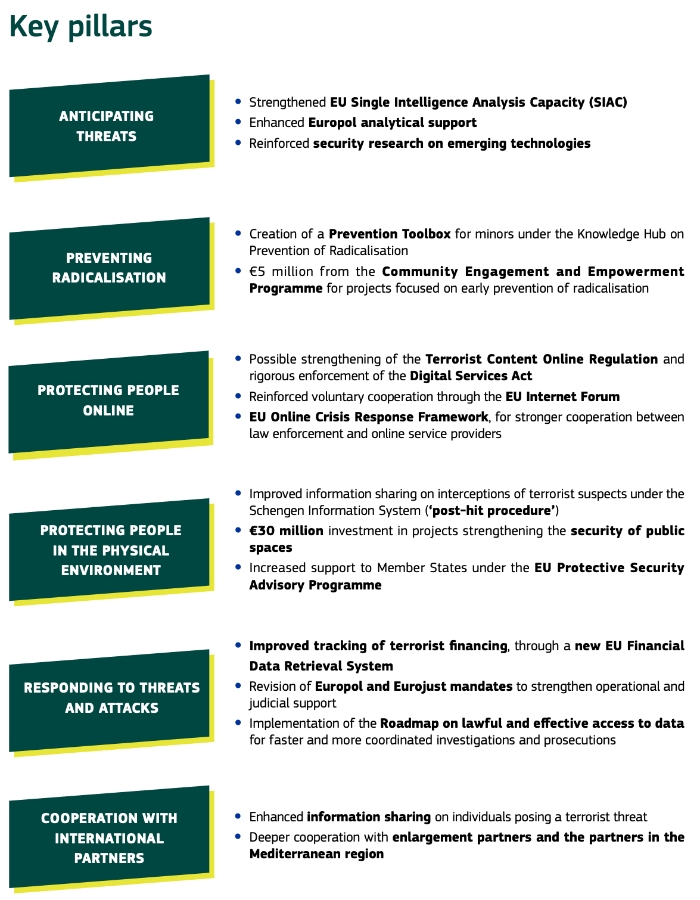
On 26 February the Commission presented a new counterterrorism agenda, read the press release and the agenda.
Some elements of the agenda are:
- the use of AI to detect and prevent terrorism and extremism
the Commission will propose to enhance Europol’s analytical support, including open-source intelligence (OSINT) capacities. (…)
The Commission will adopt guidelines to support law enforcement and the judiciary in improving their ability to detect and prevent threats with certified trustworthy AI systems for high-risk uses, while respecting fundamental rights. (…)
- extended travel surveillance
In addition, advance travel information (such as Advanced Passenger Information (API) and Passenger Name Record (PNR) data) is indispensable for law enforcement authorities to effectively plan and efficiently deploy counter terrorism efforts both at the external borders and within the EU territory. The current EU framework is limited to commercial air transport, resulting in legal and operational loopholes that terrorists may exploit to move across the EU. The Commission, in close coordination with Member States and the transport industry, is exploring options to expand the current framework to other modes of transport such as maritime and land transport, and to private flights, and to strengthen the PNR Directive, subject to its evaluation
- new measures against the financing of terrorism (financing of terrorism is a questionable concept, now that terrorism can be financed by anything, including legal sources such as salaries)
In order to close existing gaps in tracking terrorist financing, the Commission will launch a study in early 2026 to assess and identify the measures necessary to establish a future new EU-wide system to enable the retrieval of financial data for the purpose of tracking terrorist financing and organised crime proceeds. This system should be established by 2030 and aim to cover intra-EU and Single European Payment Area (SEPA) transactions, crypto asset transfers, online and wire payments or transfers.
It is interesting to see that the US is necessary to search the Swift financial messaging data:
Furthermore, since 2010 the EU-US Terrorist Finance Tracking Program (TFTP) Agreement allows Member States, Europol and Eurojust to request the U.S. Treasury to search financial messaging data, providing valuable leads to identify terrorists and their financiers.
Media
Netzpolitik published the article ‘EU relies on artificial intelligence to combat terrorism‘ [*], with this introduction [*]:
In its new anti-terrorism strategy, the European Commission is placing heavy emphasis on AI-supported data analysis and predictions. In addition to looking into the digital crystal ball, it also wants to use more upload filters and focus more closely on online gaming.
[*] Machine translation of: “Neue Strategie: “EU setzt auf Künstliche Intelligenz gegen Terror. In ihrer neuen Anti-Terror-Strategie setzt die EU-Kommission stark auf KI-gestützte Datenanalysen und Vorhersagen. Neben dem Blick in die digitale Glaskugel will sie unter anderem auch mehr Uploadfilter einsetzen – und Online-Gaming stärker ins Visier nehmen.”
From the factsheet:



 Ellen Timmer - juridische artikelen en berichten