
The concept of beneficial ownership is confusing, e.g. because it is not only applying to owners. Beneficialownerology is a legal specialism practiced primarily by tax lawyers. That is not without reason, as the first beneficial owners have popped up in tax law. Nowadays there are many variations.
Beneficial owner in the UK
An example is the beneficial owner in the UK register of overseas entities (non-UK entities) that own land or property in the UK. On this page is explained that the beneficial owner can be a:
- an individual person
- another legal entity, such as a company
- a government or public authority
- a trustee of a trust
- a member of a firm that is not a legal person under its governing law
that has significant influence or control over the non-UK entity [*]. This is explained as follows:
You must register any beneficial owner that meets one or more of the following conditions known as the ‘natures of control’.
The beneficial owner is an individual person, other legal entity, government or public authority and:
• holds, directly or indirectly, more than 25% of the shares in the entity
• holds, directly or indirectly, more than 25% of the voting rights in the entity
• holds the right, directly or indirectly, to appoint or remove a majority of the board of directors of the entity
• has the right to exercise, or actually exercises, significant influence or control over the entityThe beneficial owner is a trustee of a trust and:
• the trustees of that trust (in their capacity as such) hold, directly or indirectly, more than 25% of the shares in the entity
• the trustees of that trust (in their capacity as such) hold, directly or indirectly, more than 25% of the voting rights in the entity
• the trustees of that trust (in their capacity as such) hold the right, directly or indirectly, to appoint or remove a majority of the board of directors of the company
• the trustees of that trust (in their capacity as such) have the right to exercise, or actually exercise, significant influence or control over the companyThe beneficial owner is a member of a firm that is not a legal person under its governing law and:
• the members of that firm (in their capacity as such) hold, directly or indirectly, more than 25% of the shares in the entity
• the members of that firm (in their capacity as such) hold, directly or indirectly, more than 25% of the voting rights in the entity
• the members of that firm (in their capacity as such) hold the right, directly or indirectly, to appoint or remove a majority of the board of directors of the company
• the members of that firm (in their capacity as such) have the right to exercise, or actually exercise, significant influence or control over the company
Of course, problems arise over the criterion ‘has/have the right to exercise, or actually exercise, significant influence or control over the company‘, that is not explained on the page.
Extra information is found in this manual:

In the following six paragraphs the subject is explained for trusts.
Service providers afraid of falling under the definition can rest easy, as section 7.10 explains that they are not included:
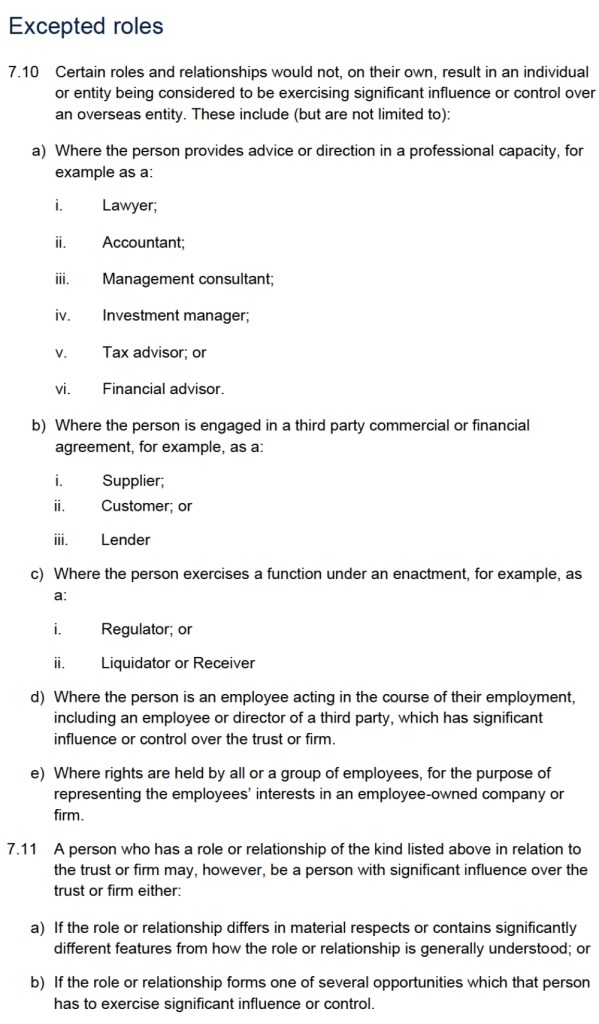
Of course, mistakes made in registering the beneficial owner are an interesting source of revenue for the UK.
Beneficialownerology is a lawyer’s paradise!
Note
[*] In the EU beneficial owners can only be individuals.
You find my previous beneficialownerology article here.



 Ellen Timmer - juridische artikelen en berichten